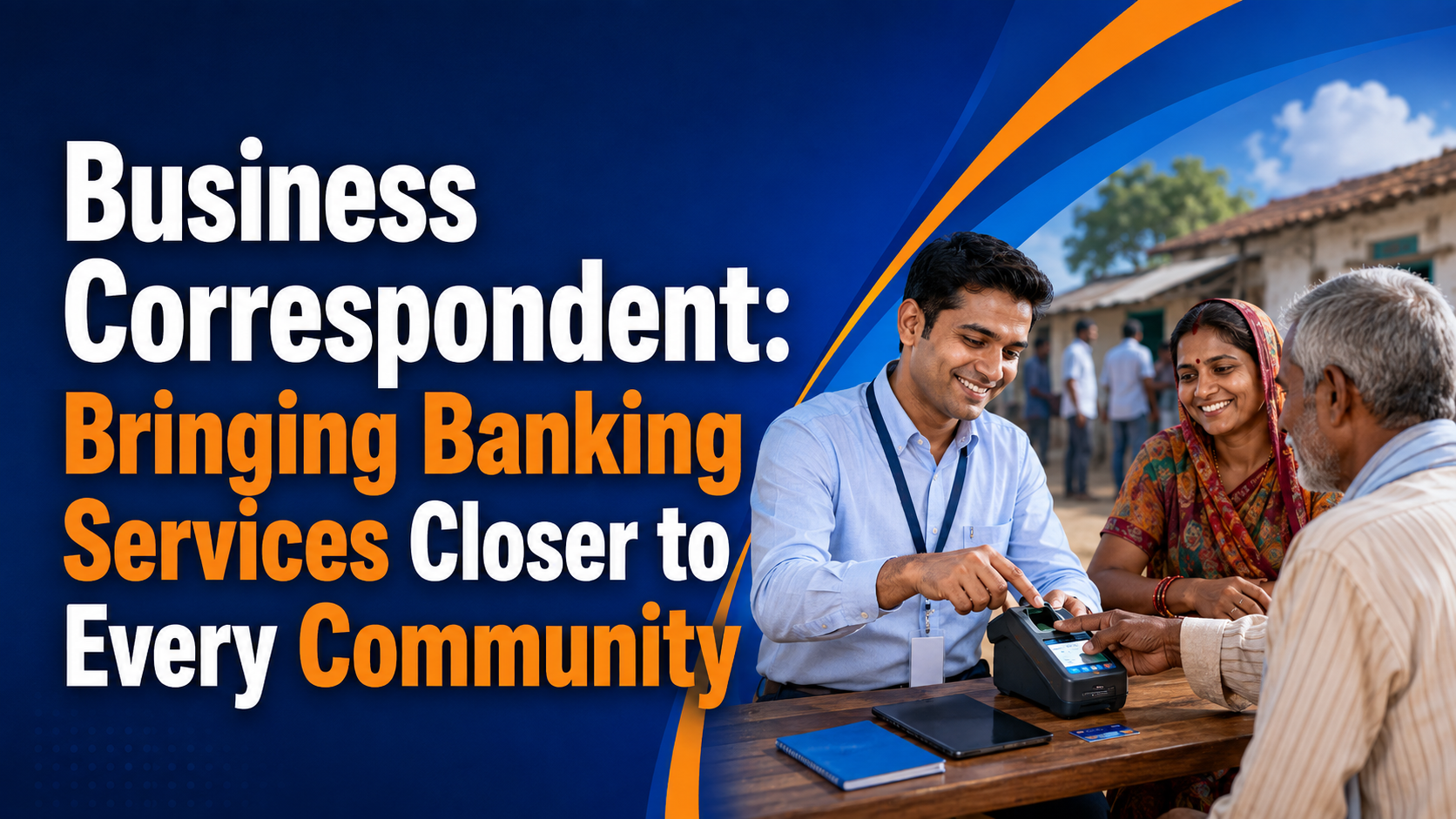
Business Correspondent: Bringing Banking Services Closer to Every Community
Access to banking has improved significantly across India, but many customers still prefer simple, nearby support for everyday financial transactions. In rural areas, semi-urban locations and even busy neighbourhoods, travelling to a bank branch for every basic transaction may not always be convenient.
This is where a Business Correspondent, commonly known as a BC, plays an important role.
A Business Correspondent acts as an authorised banking service point that helps extend selected banking and financial services beyond traditional bank branches. The Business Correspondent model has been supported by the Reserve Bank of India as part of efforts to expand financial inclusion and banking access.
For retailers and entrepreneurs, becoming part of a Business Correspondent network can also create an opportunity to provide useful banking services to local customers while earning income through eligible transactions.
What Is a Business Correspondent?
A Business Correspondent is an individual or entity engaged by a bank to provide permitted banking services on its behalf.
The main purpose of the BC model is to make basic banking services available closer to customers, particularly in locations where opening or maintaining a full bank branch may not be practical.
Depending on the bank and service provider, a Business Correspondent may operate from a retail shop, service centre or dedicated banking outlet.
RBI guidelines allow banks to use Business Correspondents for extending banking services, subject to applicable rules and supervision.
How Does the Business Correspondent Model Work?
A bank or authorised BC network appoints eligible individuals or businesses after completing the required verification and onboarding process.
Once approved, the Business Correspondent can provide selected banking services using authorised digital platforms and devices.
A customer visits the BC location and requests a supported service.
The BC then completes the transaction through the authorised system after following the required customer verification process.
A typical process may look like this:
Customer visits BC point → Selects required service → Customer verification is completed → Transaction is processed → Customer receives confirmation
The exact process depends on the type of transaction and the bank or platform involved.
Services Offered by a Business Correspondent
The services available through a BC can differ depending on the bank, provider and approval.
Common services may include:
- Cash withdrawal
- Cash deposit
- Balance enquiry
- Mini statement
- Aadhaar-enabled transactions
- Money transfer
- Account-related assistance
- Customer onboarding support
- Collection of certain banking documents
- Other permitted banking services
The availability of each service should always be confirmed with the authorised bank or BC provider.
AEPS Through Business Correspondents
AEPS, or Aadhaar Enabled Payment System, is one of the important services that may be available through Business Correspondent touchpoints.
NPCI describes AEPS as a bank-led model that enables interoperable financial transactions using Aadhaar authentication at banking service points. Supported services can include cash withdrawal, cash deposit, balance enquiry, mini statement and fund transfer, depending on availability.
For customers, this can make basic banking more accessible without requiring a traditional bank branch visit.
For Business Correspondents, AEPS can become an important part of their daily service offering.
Why Are Business Correspondents Important?
India has thousands of villages, towns and local communities where customers may need easier access to banking services.
A nearby BC point can reduce the distance customers need to travel for basic banking needs.
Business Correspondents can be especially useful for:
- Rural communities
- Senior citizens
- Small business owners
- Daily wage workers
- Customers without easy branch access
- Customers requiring assisted digital banking
- People who prefer local banking support
The BC model therefore acts as a bridge between banks and customers.
Benefits for Customers
One of the biggest benefits of a Business Correspondent is convenience.
Customers can access selected banking services from a nearby location instead of travelling long distances.
This can save both time and transportation costs.
Business Correspondents may also help customers who are less familiar with digital banking applications by providing assisted transaction support.
In areas with limited banking infrastructure, a trusted BC point can become an important local financial service centre.
Benefits for Retailers and Entrepreneurs
For an existing retailer, adding Business Correspondent services may provide an additional business opportunity.
A shop that already receives regular customer traffic may be able to offer banking services along with its existing products or digital services.
For example, a mobile shop, grocery store or digital service centre may be able to provide approved banking transactions after completing the required BC onboarding.
This can help increase customer footfall and create opportunities for commission-based income on eligible services.
How Does a Business Correspondent Earn?
The earning model generally depends on the bank or BC service provider.
A Business Correspondent may receive commissions or service-based earnings for eligible transactions.
Income can depend on factors such as:
- Number of transactions
- Type of banking service
- Transaction volume
- Provider commission structure
- Customer demand
- Location
- Operating hours
There is no fixed income that applies to every Business Correspondent.
A busy BC location with regular customer activity may naturally have greater earning potential than a low-traffic location.
Who Can Become a Business Correspondent?
Eligibility depends on the bank or authorised service provider.
Potential applicants may include:
- Existing shop owners
- Retailers
- Entrepreneurs
- Digital service centre operators
- Self-employed individuals
- Small business owners
- Other eligible individuals or organisations
RBI rules provide a framework under which banks may engage different categories of entities as Business Correspondents.
Applicants must still satisfy the specific onboarding and verification requirements of the bank or provider they are applying through.
Basic Requirements for a BC Outlet
Requirements can vary, but applicants may generally need a suitable place to operate and access to required digital infrastructure.
Depending on the provider, requirements may include:
- Smartphone or computer
- Reliable internet connection
- Biometric device
- Micro ATM or supported transaction device
- Printer, where required
- Basic shop or office space
- Valid bank account
- KYC documents
Some locations may also require proper branding, customer service arrangements and security measures.
Documents Commonly Required
The exact documentation depends on the provider, but applicants may commonly be asked for:
- Aadhaar card
- PAN card
- Passport-size photograph
- Address proof
- Bank account details
- Shop or business proof
- Rental agreement or ownership proof
- Educational or other eligibility documents where applicable
Additional verification may be required before activation.
Importance of Customer Trust
A Business Correspondent handles sensitive financial transactions.
Because of this, customer trust is extremely important.
BC operators should always clearly explain transaction amounts and applicable charges.
Customers should receive proper confirmation for completed transactions.
A Business Correspondent should never ask customers to share unnecessary passwords, OTPs or other confidential banking credentials.
Customer Aadhaar and biometric information should also be handled only through authorised systems and according to applicable requirements.
Security and Compliance
Business Correspondents operate as part of an authorised banking ecosystem and must follow the procedures specified by the bank or provider.
RBI has established guidelines covering the use of Business Correspondents as part of banking service delivery and financial inclusion.
BC operators should use only authorised devices and software.
They should also keep transaction records where required, follow KYC procedures and immediately report technical or suspicious activities through official support channels.
Business Correspondent Opportunities in Rural Areas
The BC model can be particularly valuable in rural and semi-urban locations.
A village may not have a full bank branch nearby, but customers may still require cash withdrawal, deposits, balance enquiry and other banking services.
A properly located BC outlet can provide these services within the community.
This can help improve access to banking while also creating a local service-based business opportunity.
How to Build a Successful BC Business
Location and customer service can have a major impact on the performance of a BC outlet.
Choose a location where people regularly require banking services.
Clearly display the available services so customers understand what they can access.
Maintain sufficient operational balance or cash availability according to provider requirements.
Provide transparent and professional service.
Customers who receive reliable assistance are more likely to return for future transactions.
BC operators may also provide other authorised digital services such as bill payment or recharge where supported, creating a broader financial service point.
Business Correspondent Services with YoursPay
YoursPay provides digital financial solutions and retailer-oriented services designed to support customers and entrepreneurs.
Individuals interested in exploring Business Correspondent services can contact YoursPay to understand current availability, eligibility, onboarding procedures and supported banking services.
The exact services, transaction limits, commissions and requirements may depend on the authorised banking partner and current program terms.
Applicants should review all official terms and understand the complete service model before starting operations.
Final Thoughts
A Business Correspondent plays an important role in bringing basic banking services closer to customers.
By connecting banks with local communities, BC outlets can help customers access selected financial services without always visiting a traditional bank branch.
For retailers and entrepreneurs, the Business Correspondent model may also create an additional service-based income opportunity when operated through authorised channels.
Success depends on choosing the right location, following proper banking procedures, maintaining customer trust and consistently providing reliable service.
As financial inclusion and assisted digital banking continue to expand across India, Business Correspondents are likely to remain an important part of the country’s banking ecosystem.