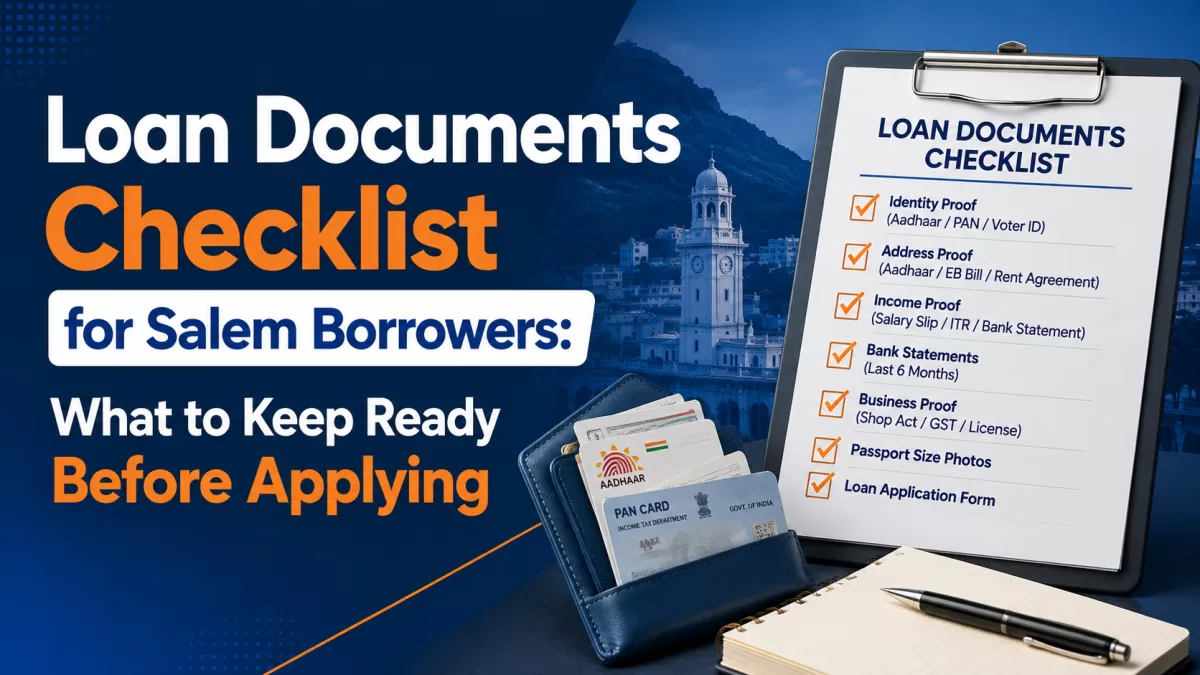
Loan Documents Checklist for Salem Borrowers: What to Keep Ready Before Applying
Applying for a loan becomes much easier when you have the required documents ready in advance.
Whether you are applying for a Gold Loan, Personal Loan, Business Loan, Home Loan or another financial product in Salem, lenders normally verify your identity, address, income, repayment capacity and other information before approving the application.
The exact documents required can vary depending on the lender and type of loan. For example, gold loans may require relatively simple KYC documentation, while personal, business and home loans may require additional income or property-related records.
Keeping the right documents ready can help reduce delays and make the loan application process smoother.
This Loan Documents Checklist for Salem Borrowers explains the commonly required documents and how requirements may change for salaried employees, self-employed applicants and different loan types.
Why Are Documents Required for a Loan?
Banks and financial institutions need to verify that the person applying for a loan is genuine and eligible.
Documents help lenders confirm details such as:
- Identity
- Residential address
- Age
- Income
- Employment
- Business activity
- Bank transactions
- Existing financial obligations
- Ownership of assets or property where applicable
Lenders also follow Know Your Customer, or KYC, requirements.
Therefore, incomplete or incorrect documents can delay the application or require the borrower to submit additional information.
Basic KYC Documents
Almost every loan application requires basic KYC documents.
The exact combination depends on the lender.
Common documents may include:
- Aadhaar card
- PAN card
- Passport
- Voter ID
- Driving licence
- Recent photograph
RBI’s KYC framework recognises specified documents for verifying customer identity and address, although the exact documentation accepted for a particular loan depends on the regulated lender and current KYC rules.
It is always better to check whether your Aadhaar, PAN and other identification documents contain accurate and updated information before applying.
Address Proof
Lenders normally require proof of your current or permanent residential address.
Depending on the lender’s policy, accepted documents may include eligible officially valid documents containing your address.
Make sure that the name and address details on your documents are consistent.
If your current address is different from the address shown on your primary KYC document, the lender may request additional supporting documentation.
Providing accurate address information can prevent unnecessary verification delays.
PAN Card
PAN is commonly requested during loan processing.
It helps lenders complete financial and tax-related verification where applicable.
For example, SBI currently includes PAN among the documents required for its personal loan products.
If you do not have PAN or if a particular situation allows an alternative declaration, check directly with the lender regarding the applicable process.
Never provide incorrect PAN information on a loan application.
Passport-Size Photographs
Some lenders may request recent passport-size photographs.
Even when the loan application is submitted digitally, a photograph may still form part of the KYC or documentation process.
Gold loan documentation, for example, may include photographs along with identity and address proof. SBI currently lists an application with photographs and identity/address proof among its personal gold loan requirements.
Keeping a few recent photographs ready can therefore be useful when visiting a branch.
Bank Statements
Bank statements are important for many loan applications because they help lenders understand your income and financial activity.
Depending on the loan product, lenders may request several months of bank statements.
For salaried borrowers, they may check whether salary is regularly credited.
For self-employed borrowers, bank statements can help show business cash flow and transaction patterns.
SBI, for example, currently asks for six months of salary account statements for certain personal loan applications.
Avoid submitting edited or incomplete statements.
Use statements downloaded through your bank’s official system or obtained from the branch where required.
Documents for Salaried Borrowers
If you are working for a company, government department or other organisation in Salem, you may need to submit income and employment-related documents.
Common requirements may include:
- Recent salary slips
- Salary bank statements
- Employee ID
- Employment certificate
- Form 16
- Income Tax Return where applicable
- Appointment or confirmation letter in some cases
SBI’s current personal loan documentation includes salary slips, salary account statements and Form 16 or ITR-related documentation depending on the applicant’s circumstances.
The exact number of salary slips or months of bank statements required will depend on the lender.
Documents for Self-Employed Borrowers
Self-employed applicants may need to provide more detailed financial information.
This can include:
- PAN card
- Aadhaar or other KYC
- Business registration proof
- GST registration, where applicable
- Business bank statements
- Income Tax Returns
- Profit and Loss Statement
- Balance Sheet
- Business address proof
- Existing loan details
For business lending, lenders may verify both the borrower and the business entity.
Bank of Baroda’s digital MSME lending information, for example, refers to business registration details, KYC of the business and proprietor, and existing loan information.
Keeping business accounts and tax records organised can therefore make the application process easier.
Gold Loan Documents Checklist
Gold loans generally involve simpler documentation compared with several unsecured loan products because the gold is pledged as collateral.
Commonly required documents may include:
- Aadhaar or accepted identity proof
- Address proof
- PAN or Form 60 where applicable
- Recent photograph
- Gold ornaments to be pledged
- Completed loan application
SBI’s current personal gold loan checklist includes identity proof, address proof and photographs.
Another major lender, HDFC Bank, also lists documents such as Aadhaar, passport, voter ID, driving licence and PAN/Form 60 among its gold loan documentation options.
Additional documents may still be required depending on the loan purpose and lender.
Personal Loan Documents Checklist
A personal loan is generally unsecured.
Because no asset is pledged as collateral, the lender may pay greater attention to your income and credit profile.
Common documents can include:
- Aadhaar or identity proof
- PAN card
- Address proof
- Recent salary slips
- Bank statements
- Form 16
- ITR where applicable
- Employment proof
- Photograph
Self-employed applicants may need additional business and financial documentation.
Keep in mind that satisfying the document requirement does not automatically guarantee approval.
The lender may also check creditworthiness, repayment capacity and its internal eligibility criteria.
Business Loan Documents Checklist
For a business loan, the lender usually needs information about both the applicant and the business.
Documents may include:
- Aadhaar
- PAN
- Business registration certificate
- GST registration
- Udyam registration where applicable
- Current account statements
- Income Tax Returns
- Balance Sheet
- Profit and Loss Statement
- Business address proof
- Partnership deed or company documents where relevant
- Existing loan statements
- Business turnover details
Requirements can change depending on whether the business is a proprietorship, partnership, LLP or company.
Prepare both personal KYC and business records before applying.
Home Loan Documents Checklist
A home loan usually involves more documentation because both the borrower and property need to be verified.
In addition to KYC and income documents, borrowers may need property documents such as:
- Sale agreement
- Title documents
- Property tax records
- Approved building plan
- Encumbrance-related documents where applicable
- Builder documents for new projects
- Property valuation information
- Other legal records requested by the lender
Self-employed applicants may also need several years of financial statements and tax returns.
Bank of Baroda’s home-loan documentation guidance, for example, notes business address proof, tax returns and audited financial statements among documents that may be relevant for self-employed borrowers.
Because property documentation can differ significantly, always obtain the exact checklist from the lender.
Vehicle Loan Documents
Borrowers applying for a car or other vehicle loan may need:
- KYC documents
- Income proof
- Bank statements
- Vehicle quotation
- Employment or business proof
- PAN
- Photographs
The lender may also request dealer or vehicle-related documents as part of the application.
The final list will depend on whether the applicant is salaried or self-employed.
Documents for Existing Loans
If you already have another loan, the new lender may ask for information about that borrowing.
This may include:
- Existing loan account statement
- EMI details
- Outstanding balance
- Repayment history
- Credit card obligations
- Other financial commitments
Do not hide existing liabilities when completing a loan application.
Lenders may obtain information through credit bureau checks and other verification processes.
Accurate information helps avoid complications during underwriting.
Check Your Credit Profile
Credit score is especially relevant for unsecured loans such as personal loans and many business loans.
Before applying, it can be useful to review your credit report and make sure there are no obvious errors.
Late EMI payments, overdue credit card balances and excessive existing debt can affect your loan eligibility.
Gold loans may rely more heavily on collateral, but lenders may still perform applicable credit and risk checks depending on their policies.
A complete document file combined with a healthy repayment record can make the application process more straightforward.
Make Sure Names Match Across Documents
One small documentation mistake can create avoidable delays.
For example, your name may appear differently on:
- Aadhaar
- PAN
- Bank account
- Salary records
- Property documents
Minor differences in initials, spelling or date of birth can result in additional verification.
Before applying for a major loan, review your important documents and correct significant inconsistencies where necessary.
Keep Mobile Number and Bank Details Updated
Make sure the mobile number linked to important financial accounts is active.
Banks may use OTP verification or contact you during the application process.
Also ensure that the bank account details you provide are correct.
If your salary is credited to a specific bank account, use the correct statement from that account when the lender requests salary banking records.
Carry Originals When Required
Even when you submit photocopies or digital documents, the lender may ask to see originals for verification.
When visiting a branch, keep original identification and supporting documents available where requested.
Do not hand over original documents permanently unless there is a legitimate and documented requirement.
Ask for confirmation if you are unsure why an original document is being requested.
Avoid Fake or Altered Documents
Never submit fake salary slips, edited bank statements, incorrect income records or fabricated business documents.
Loan applications involve financial verification.
Providing false information may result in rejection and can create serious legal or financial consequences.
If you do not meet the eligibility conditions for a particular loan, consider reducing the loan amount or exploring another legitimate product rather than providing false documentation.
Create a Loan Document Folder
A simple way to prepare for a loan application is to create one physical or digital folder containing your key documents.
You can include:
- Aadhaar
- PAN
- Photographs
- Address proof
- Bank statements
- Salary slips
- Form 16 or ITR
- Employment proof
- Business records
- Existing loan statements
For property or business loans, create a separate section for the related documents.
Organising files in advance can make both online and offline loan applications easier.
Final Approval Depends on More Than Documents
Having all the required documents does not guarantee that a loan will be approved.
The lender may also assess:
- Income
- Creditworthiness
- Repayment capacity
- Existing debts
- Age
- Employment stability
- Business performance
- Collateral value
- Internal lending policies
For example, online loan applications may still be subject to satisfactory KYC, income, creditworthiness and document verification before final sanction.
Therefore, borrowers should treat documentation as one important part of the overall approval process.
Loan Assistance for Salem Borrowers with YoursPay
Borrowers in Salem who are exploring available loan solutions can contact YoursPay to understand the documentation required for the relevant financial service.
The document checklist may differ depending on whether you are applying for a Gold Loan or another available loan product.
Customers should provide genuine and updated documents and carefully review the eligibility requirements, interest rates, repayment terms and applicable charges before proceeding.
The YoursPay team can help eligible customers understand the available application process and documents required based on the current product and lending partner.
Final Thoughts
Preparing the right documents before applying for a loan can save time and reduce unnecessary delays.
The basic Loan Documents Checklist for Salem Borrowers generally starts with KYC documents such as identity proof, address proof and PAN.
Salaried borrowers may also need salary slips and bank statements, while self-employed applicants may need business records, ITRs and financial statements.
Gold loans may require comparatively simpler documentation, while business and home loans can involve more detailed verification.
Most importantly, obtain the exact checklist from your chosen lender before applying.
Keep your documents accurate, updated and organised, and never submit false information.
Good preparation can make the loan application process in Salem simpler, faster and easier to manage.
Related YoursPay services in Salem
- Loan eligibility and documents – know what to keep ready before you apply.
- Instant gold loan in Salem – quick disbursal with insured gold storage.
- Group loans in Salem – finance for women SHGs and small groups.
- Contact YoursPay – call, WhatsApp or visit our Salem office.