How to Use an EMI Calculator Before Taking a Loan
Taking a loan can help manage important financial needs such as buying a home, funding education, expanding a business, handling medical expenses or meeting other planned requirements.
However, before accepting any loan, it is important to understand how much you will need to repay every month.
This is where an EMI Calculator becomes useful.
An EMI Calculator helps you estimate your monthly loan repayment based on the loan amount, interest rate and repayment tenure.
By checking the EMI before borrowing, you can understand whether the monthly repayment fits comfortably within your budget.
Using an EMI calculator may take only a few minutes, but it can help you avoid taking a loan that becomes difficult to manage later.
What Is EMI?
EMI stands for Equated Monthly Instalment.
It is the fixed amount you generally pay every month toward a loan.
An EMI usually includes two main components:
- Principal repayment
- Interest charged by the lender
At the beginning of a loan, a larger portion of the EMI may go toward interest. Over time, more of the payment may go toward reducing the principal, depending on the loan structure.
The EMI amount depends mainly on:
- Loan amount
- Interest rate
- Loan tenure
Changing any of these factors can affect your monthly payment.
What Is an EMI Calculator?
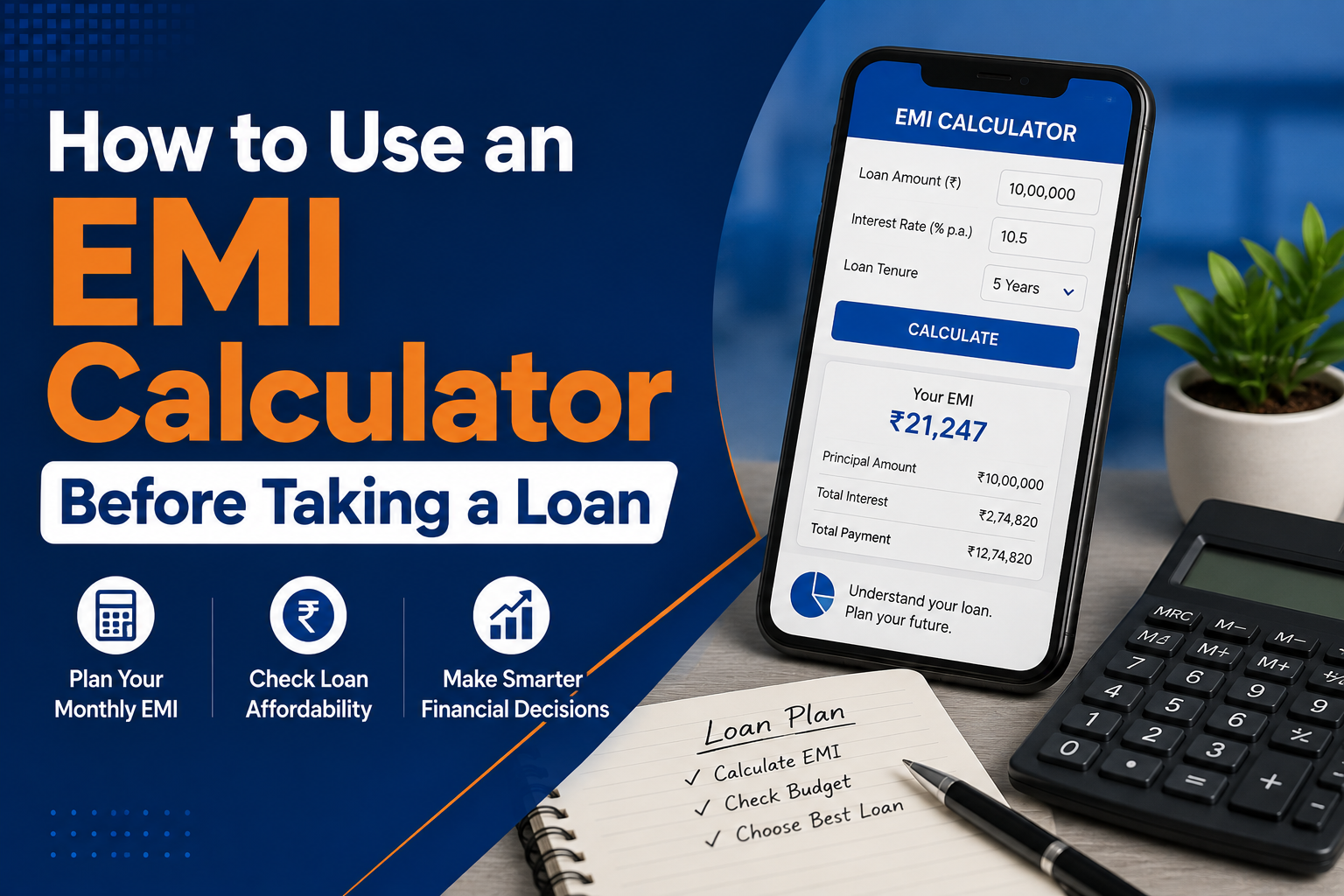
An EMI Calculator is a simple financial tool that estimates your monthly repayment before you take a loan.
You enter basic loan details such as:
Loan Amount – How much money you plan to borrow.
Interest Rate – The annual interest rate applicable to the loan.
Loan Tenure – How long you plan to take to repay the loan.
The calculator then estimates the monthly EMI.
Many calculators also show:
- Total interest payable
- Total repayment amount
- Principal amount
- Repayment period
These estimates can help you compare different loan options more easily.
Why Should You Use an EMI Calculator Before Taking a Loan?
A loan should always fit your financial situation.
An EMI Calculator helps you understand the repayment responsibility before signing the loan agreement.
For example, a loan may initially appear affordable because the monthly EMI looks small.
However, if the tenure is very long, the total interest paid over the life of the loan may become significantly higher.
An EMI calculator allows you to see both the monthly repayment and the long-term cost.
This makes it easier to make a better-informed borrowing decision.
Step 1: Enter the Loan Amount
Start by entering the amount you want to borrow.
For example, suppose you are considering a loan of ₹5,00,000.
Enter ₹5,00,000 as the loan amount.
Do not automatically enter the maximum loan amount the lender is willing to offer.
Instead, calculate how much you genuinely need.
Borrowing less usually means:
- Lower EMI
- Lower total interest
- Easier repayment
- Reduced financial pressure
Always begin with your actual requirement.
Step 2: Enter the Interest Rate
Next, enter the annual interest rate offered by the lender.
For example, if the lender offers a loan at 12% per annum, enter 12%.
Interest rates can significantly affect your EMI.
Even a small difference in the rate can create a noticeable difference in total repayment, especially on larger or longer-term loans.
When comparing lenders, always use the actual rate applicable to your loan rather than only an advertised “starting from” rate.
Step 3: Select the Loan Tenure
Loan tenure means the period over which you will repay the loan.
It may be expressed in months or years.
For example:
- 12 months
- 24 months
- 36 months
- 5 years
- 10 years
A longer tenure usually reduces the monthly EMI.
However, it can increase the total interest paid.
A shorter tenure usually increases the monthly EMI but can reduce the total interest cost.
Therefore, the best tenure is not always the longest available option.
Choose a tenure that gives you a manageable monthly repayment without unnecessarily increasing the overall cost.
Step 4: Check the Estimated EMI
Once the loan amount, interest rate and tenure are entered, the calculator displays the estimated monthly EMI.
Now compare the EMI with your regular monthly income and expenses.
Ask yourself:
Can I comfortably pay this amount every month?
Will I still have enough money for:
- Rent
- Household expenses
- Education costs
- Medical expenses
- Insurance
- Existing EMIs
- Emergency savings
If the EMI leaves very little money for essential expenses, the loan may be too large.
Step 5: Check the Total Interest Payable
Do not look only at the monthly EMI.
Also check how much total interest you may pay over the entire loan period.
For example, two loans may have similar monthly EMIs, but the longer loan may result in significantly more interest.
Understanding the total interest helps you see the real cost of borrowing.
This is especially important for long-term loans.
Step 6: Compare Different Tenures
One of the best ways to use an EMI calculator is to test different repayment periods.
Suppose you are borrowing ₹5,00,000.
You can calculate the EMI for:
- 2 years
- 3 years
- 4 years
- 5 years
You may notice that the EMI becomes smaller as the tenure increases.
However, the total interest may increase.
By comparing these options, you can find a balance between affordable monthly payments and reasonable total interest.
Step 7: Compare Different Loan Amounts
If the EMI is too high, consider reducing the amount you borrow.
For example, instead of taking ₹6,00,000, check the EMI for ₹5,00,000.
Even a small reduction in the loan amount can reduce both the EMI and total interest.
This is why it is important to borrow only what you actually require.
A larger sanctioned amount does not mean you need to take the entire amount.
Step 8: Compare Different Interest Rates
An EMI calculator is also useful when comparing loan offers from different lenders.
Suppose one lender offers 11% interest while another offers 13%.
Enter both rates using the same loan amount and tenure.
This will show you how much the interest rate affects:
- Monthly EMI
- Total interest
- Total repayment
This makes lender comparison more practical.
EMI Example
Suppose you are planning to take a loan of ₹3,00,000 at an annual interest rate of 12% for 3 years.
An EMI calculator will estimate the monthly repayment based on these details.
If you increase the tenure to 5 years, the monthly EMI will normally decrease.
But because you are repaying the loan for a longer period, the total interest payable may increase.
This example shows why choosing a loan only based on a lower EMI can sometimes be misleading.
Always check the complete repayment amount.
EMI Calculator for Personal Loans
Personal loans are generally unsecured loans.
Because they do not require collateral, interest rates may be higher than some secured loan products.
Before taking a personal loan, calculate the EMI using the actual interest rate offered to you.
Check whether the monthly payment fits comfortably with your salary or business income.
Do not take a high-value personal loan simply because it is quickly approved.
EMI Calculator for Gold Loans
Gold loans can have different repayment structures.
Some may use monthly EMI, while others may allow periodic interest payments or bullet repayment.
If you are selecting an EMI-based Gold Loan, a calculator can help estimate your monthly commitment.
For other repayment structures, you should calculate the total interest and maturity obligation separately.
Always ask the lender to explain the repayment method clearly.
EMI Calculator for Home Loans
Home loans usually involve larger amounts and longer repayment periods.
Even a small difference in interest rate can make a significant difference over a long tenure.
Using an EMI calculator can help home loan borrowers compare:
- 10-year tenure
- 15-year tenure
- 20-year tenure
- Different loan amounts
- Different interest rates
This can make long-term planning easier.
EMI Calculator for Business Loans
Business owners should be particularly careful when selecting a loan EMI.
Business income can sometimes vary from month to month.
Before borrowing, calculate whether the business can generate enough regular cash flow to cover the EMI.
Avoid using your entire expected profit for loan repayment.
The business should still have enough working capital for:
- Staff salaries
- Inventory
- Rent
- Utilities
- Supplier payments
- Taxes
- Emergency expenses
A loan should support business growth, not create continuous cash-flow pressure.
How Much EMI Can You Afford?
There is no single percentage that works for every borrower.
Your affordable EMI depends on:
- Monthly income
- Existing debts
- Household expenses
- Number of dependents
- Savings
- Job or business stability
Before taking a new loan, calculate your current monthly commitments.
Then determine how much additional EMI you can comfortably manage.
Always leave some room in your budget for unexpected expenses.
Do Not Ignore Existing Loans
If you already have a home loan, vehicle loan, credit card balance or another EMI, include those payments when planning a new loan.
For example, if you already pay ₹20,000 every month toward existing debts, adding another ₹15,000 EMI means your total monthly debt repayment becomes ₹35,000.
Consider the complete financial picture rather than evaluating the new loan separately.
Check Processing Fees and Other Charges
An EMI Calculator usually focuses on principal and interest.
But your actual loan cost may include additional charges.
These can include:
- Processing fee
- Documentation charges
- Insurance costs
- Late-payment charges
- Prepayment charges
- Other applicable fees
Therefore, the EMI shown by a calculator should be treated as an estimate.
Always review the lender’s complete fee structure before taking the loan.
Fixed vs Floating Interest Rates
Some loans may have fixed interest rates, while others may use floating rates.
With a fixed interest rate, the applicable rate generally remains unchanged for the agreed period, subject to the product terms.
With a floating rate, the interest rate may change based on the lender’s benchmark or applicable market conditions.
If the rate changes, your EMI, tenure or overall repayment may also change depending on the loan agreement.
This is particularly important for long-term loans.
Common Mistakes While Using an EMI Calculator
One common mistake is entering an unrealistically low interest rate.
Always use the rate actually offered to you.
Another mistake is choosing a very long tenure only to get the lowest possible EMI.
A lower monthly payment does not automatically mean a cheaper loan.
Also, do not forget existing debts and monthly household expenses.
The purpose of the calculator is not simply to find the lowest EMI.
It is to find a repayment amount that is financially manageable.
How an EMI Calculator Helps in Loan Planning
Using an EMI Calculator before taking a loan can help you:
- Plan your monthly budget
- Compare lenders
- Compare loan tenures
- Estimate total interest
- Avoid excessive borrowing
- Select a suitable loan amount
- Understand repayment responsibilities
It gives you a clearer picture of the financial commitment before the loan begins.
Loan Solutions with YoursPay
YoursPay provides financial services for customers exploring different borrowing options.
Before applying for a loan through an available financial service, customers can estimate their repayment capacity using an EMI Calculator and compare different loan amounts and tenures.
Customers should also confirm the current interest rate, applicable charges, repayment structure and eligibility before proceeding.
The YoursPay team can provide information about available loan services and help customers understand the relevant application process based on current terms.
Final Thoughts
Learning how to use an EMI Calculator before taking a loan is one of the simplest ways to make a more informed borrowing decision.
Enter the loan amount, interest rate and tenure, then check both the estimated monthly EMI and total interest payable.
Try different combinations before deciding.
A lower EMI may feel comfortable, but a very long tenure can increase the overall cost of the loan.
The best loan is not necessarily the one with the highest approved amount or the lowest monthly EMI.
It is the loan that matches your actual requirement and can be repaid comfortably without affecting essential expenses or savings.
Use an EMI calculator before borrowing, understand all loan terms and choose a repayment plan that fits your financial situation.