ATM Franchise Location in Salem: Low-Footfall vs High-Footfall Spots
Your ATM franchise location will shape your results more than almost any other decision. In Salem, two kiosks with the same machine and the same plan can see very different numbers of users, simply because one stands near a crowded bus stand and the other on a quiet residential lane. Yet busier is not always better.
This guide compares high-footfall and low-footfall spots honestly. It explains what footfall really means for a cash machine, how to count it properly, how to read the competition around you, and which checks matter beyond the crowd. It is written for shop owners, retirees, homemakers and first-time investors in Salem, Attur, Namakkal, Erode, Mettur and nearby villages.
YoursPay details below come from its ATM franchise page at the time of writing. They are indicative and may change, so confirm the current terms in writing before you invest.
Table of Contents
Why the ATM Franchise Location Matters So Much
An ATM kiosk earns commission per transaction. The YoursPay page explains that you receive commission on every withdrawal, deposit, AEPS and BBPS transaction, and that a well-placed kiosk in a busy neighbourhood drives more daily transactions. It also states that income figures depend on location footfall and that a fixed monthly income is not guaranteed.
In other words, the machine is the same everywhere, but the location decides how often it is used. That is why choosing an ATM franchise location deserves weeks of observation, not a single visit.
The page also lists the kinds of places YoursPay considers suitable:
- Commercial areas
- Shopping centres
- Educational institutions
- Residential communities
- Semi-urban and rural markets
Every one of these can suit an ATM kiosk, and every one can fail. The difference lies in the details of the exact spot you choose.
What Footfall Really Means for an ATM
Footfall is the number of people who pass a spot. For an ATM franchise location, it is only the first step. Not everyone who walks past needs cash, and not everyone who needs cash will use your machine.
Think of it as three layers:
- People passing: everyone who walks or rides past your spot in a day.
- People needing cash: those who will pay someone in cash soon, such as a vegetable vendor, an auto driver or a local shop.
- People choosing your kiosk: those who find your machine more convenient than their other options, such as a bank ATM, an AEPS counter or cash back at a shop.
A spot with huge footfall but many convenient alternatives may convert only a small share. A quieter spot where people badly need cash and have no nearby option may convert a much larger share. Keep this three-layer picture in mind as you compare places.
High-Footfall Spots: Strengths and Trade-offs
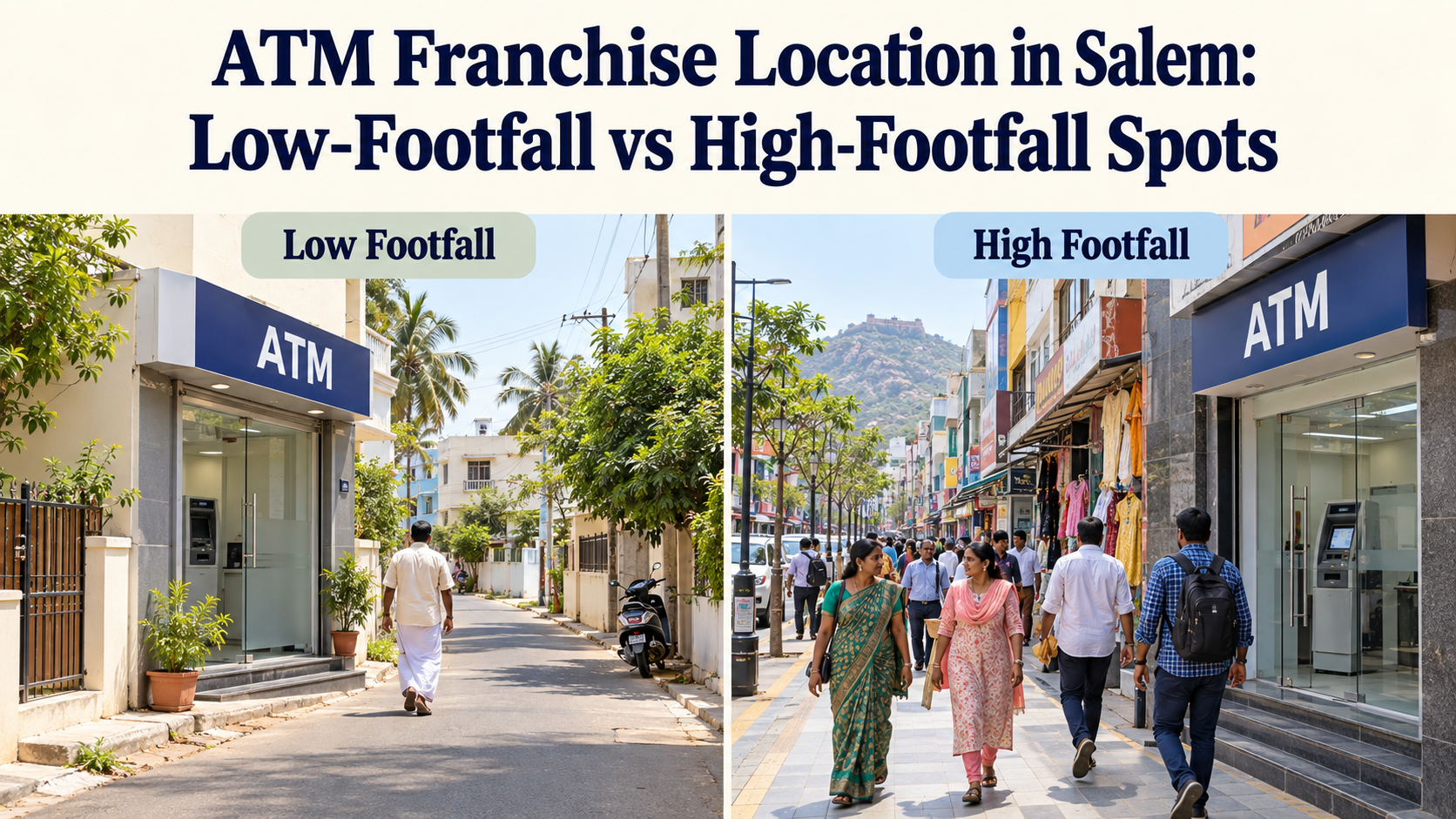
High-footfall spots include areas around bus stands, main bazaar streets, busy junctions, hospital entrances, college gates and large shopping complexes. They are the first places most investors think of when planning an ATM kiosk.
Their strengths are real:
- More people pass every hour, so more potential users see the ATM kiosk.
- Visibility is high, which builds awareness quickly.
- Demand continues late into the evening in many commercial areas.
Their trade-offs are just as real:
- Higher rent and advance: busy frontage costs more, and owners may prefer other tenants.
- More competition: bank ATMs tend to cluster in the same busy areas.
- Crowding: a cramped frontage, parked vehicles or hawkers can hide your kiosk.
- Security needs: crowds attract pickpockets and fraud attempts, so lighting and safety notices matter more.
A high-footfall ATM franchise location works best when the crowd is large and the existing machines nearby are few, crowded or often out of cash.
Low-Footfall Spots: When Quiet Can Still Work
Low-footfall spots include residential streets, village centres, small market lanes in semi-urban areas and neighbourhoods away from the main roads. Many ATM franchise investors dismiss them too quickly.
A quiet spot can still work when:
- The nearest ATM is far away, and people currently travel for cash.
- Residents are regular and loyal, so users return week after week.
- Rent is low, or you already own the space.
- Local shops handle a lot of cash and would welcome a nearby machine.
The risks are also clear. Fewer passers-by mean fewer transactions, awareness builds slowly, and power and internet reliability can be weaker in some outlying areas. A low-footfall ATM franchise location needs strong evidence of unmet cash demand, not just cheap rent.
High-Footfall vs Low-Footfall: A Side-by-Side View
This table brings the main differences together. Use it as a starting point for your own comparison rather than a final verdict.
| Factor | High-footfall spot | Low-footfall spot |
|---|---|---|
| People passing | Many, all day | Fewer, often at set times |
| Rent and advance | Usually higher | Usually lower |
| Nearby competition | Often several ATMs | Often none or one |
| Share of passers-by who use your kiosk | Can be small if alternatives are close | Can be large if no alternative exists |
| Awareness building | Fast | Slow, often by word of mouth |
| Power and internet | Usually more reliable | Check carefully |
| Safety concerns | Crowd-related | Isolation after dark |
Notice that neither column wins on every row. The best ATM franchise location is the one where the balance of these factors works in your favour.
How to Count Footfall Properly
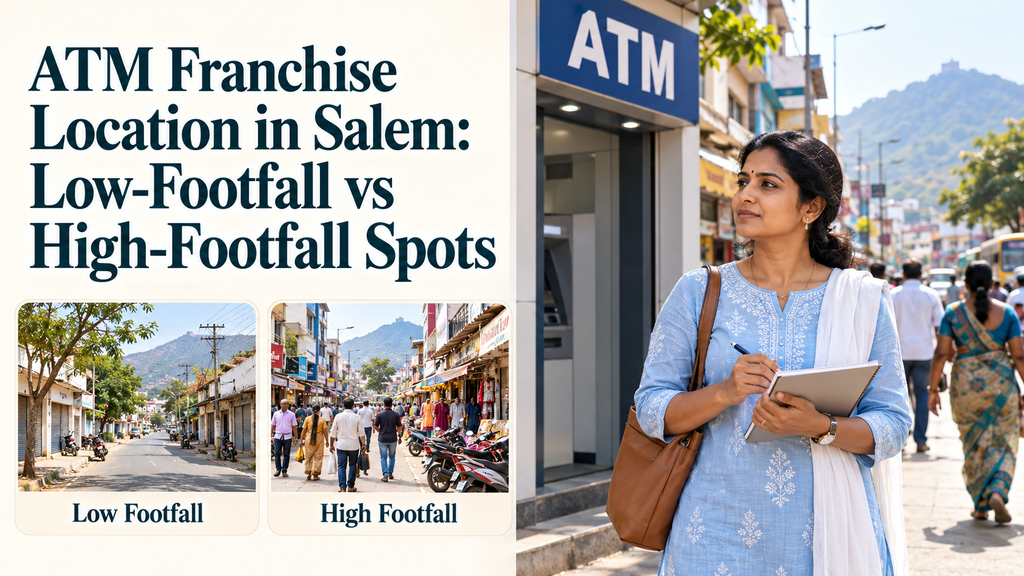
A single visit can mislead you. A spot that looks busy on a Saturday evening may be empty on a Tuesday morning. Counting properly takes a few days, but it is the most useful research you can do.
Use a simple tally method:
- Pick four time slots: early morning, late morning, early evening and late evening.
- In each slot, count people passing for 15 minutes using tally marks in a notebook.
- Repeat on a weekday, a weekend day and, if there is one nearby, a weekly market day.
- Also count how many people use the nearest existing ATM during 30 minutes in the evening.
- Note who passes: workers, shoppers, students, families or travellers.
| Time slot | Weekday count | Weekend count | Market day count |
|---|---|---|---|
| Early morning | |||
| Late morning | |||
| Early evening | |||
| Late evening |
Do the same exercise for every possible ATM franchise location on your shortlist. The comparison between spots is often more revealing than the raw numbers.

Checking the Competition Around Your Spot
Competition is the other half of the location picture. Walk every street within a comfortable walking distance of your proposed ATM kiosk and note each cash access point you find.
- Bank ATMs: note the bank, whether the machine was working and whether it had cash, especially on weekends and evenings.
- Cash deposit machines: important if you are considering the CDM kiosk.
- AEPS counters: shops offering Aadhaar-based cash withdrawal, a service built on the NPCI payment network.
- Queues: long queues at existing machines are a sign of unmet demand.
An area with one frequently empty bank ATM can be a stronger ATM franchise location than an area with no ATM but also few people. Record what you see on several days, because machine availability changes from day to day.
Cash-Need Signals to Look For
Beyond counting people, look for signs that people around your spot regularly need cash. These signals often matter more than the raw crowd.
- Weekly shandy or market days when traders and buyers deal mostly in cash.
- Workshops, mills or small factories where workers may draw cash on pay days.
- Hospitals and clinics where families need cash for pharmacies, canteens and travel.
- Temples and wedding halls with steady visitor traffic on auspicious days.
- Wholesale and farm produce markets where early-morning trading runs on cash.
Ask three or four shopkeepers near the spot a simple question: “When customers do not have cash, where do they go?” Their answers tell you whether your ATM kiosk would fill a real gap.
Seasonal and Weekly Patterns to Expect
Footfall at any ATM franchise location rises and falls through the week, the month and the year. Knowing the pattern in advance helps you judge a spot fairly and plan for slower periods.
- Month start: many salaried and daily-wage households draw more cash in the first days of the month.
- Festival seasons: Pongal, Deepavali and local temple festivals usually bring extra shopping and cash use.
- Wedding months: areas near marriage halls and jewellery or textile shops can see strong cash demand.
- College terms: kiosks near colleges may be quiet during vacations.
- Harvest time: farming areas around Salem often handle more cash when crops are sold.
- Heavy rain: footfall drops on rainy days, especially at open, uncovered spots.
Ask long-standing shopkeepers which months are busy and which are slow in their street. Then plan your household budget around the slow months, not the festival peaks.
Matching the Kiosk Type to the Location
YoursPay offers a withdrawal kiosk and a deposit and withdrawal kiosk (CDM). The location should guide which one you consider.
| Location type | Kiosk to consider | Reason |
|---|---|---|
| Transit points and residential streets | Withdrawal kiosk | Most users need to take cash out |
| Trader clusters and wholesale markets | CDM kiosk | Shops need a nearby place to deposit cash |
| Village centres far from a bank | Either, based on demand | Ask local traders whether deposits are a need |
Current plan amounts on the YoursPay page are Rs 3,99,999 with a Rs 1,00,000 refundable deposit for the withdrawal kiosk, and Rs 5,50,000 with a Rs 1,50,000 refundable deposit for the CDM. Confirm the latest figures before deciding.
Practical Checks Beyond Footfall
Even a spot with good footfall and clear cash demand can fail on practical details. YoursPay asks for a minimum 8 x 8 sq.ft space with electricity and internet. Check these points at the exact spot, not just in the area.
- Line of sight: can people see the kiosk and its branding from both directions of the road?
- Easy access: is the entrance step-free or at least easy for older users?
- Parking: can a two-wheeler stop briefly in front without blocking traffic?
- Rain: does water collect in front of the spot during heavy rain?
- Night safety: is the street lit and busy enough to feel safe after dark?
- Power and signal: how frequent are power cuts, and how strong is mobile signal inside the space?
- Landlord terms: will the owner allow branding and offer a lease long enough to build a customer base?
Red Flags That Should Make You Walk Away
Some problems cannot be fixed by good service or branding. If you see any of these at a shortlisted spot, it is usually wiser to keep looking.
- The kiosk would be hidden behind a staircase, pillar or parked vehicles.
- Water collects in front of the space every time it rains heavily.
- The owner will not give a written lease or refuses permission for branding.
- You hear of planned road widening or building work that could block the frontage; confirm with the local body.
- The street becomes deserted and poorly lit soon after dark.
- Mobile signal inside the space is weak and wired broadband is not available.
- Several working ATMs stand within a short walk and none of them ever has a queue.
Walking away from a weak spot costs you only time. Setting up in the wrong ATM franchise location can cost you months of low income and a second round of setup work if you later relocate.
Salem Area Types at a Glance
Salem and its nearby towns offer many kinds of locations. The table below describes general patterns only. Your own counts and observations should always override them.
| Area type | Typical footfall pattern | What to check first |
|---|---|---|
| Bus stands and main bazaar streets | Heavy all day and evening | Number of ATMs already nearby, rent level |
| College and hospital zones | Peaks at set hours | Holiday seasons, visiting hours, existing machines |
| Residential layouts | Morning and evening peaks | Distance to the nearest ATM, evening safety |
| Workshop and small-industry belts | Peaks around shift times and pay days | Cash usage by workers and suppliers |
| Town markets in Attur, Omalur or Mettur | Strong on market days | Deposit demand from traders, weekday quietness |
| Village centres | Light but steady, loyal users | Power, internet signal and distance to the nearest bank |
Remember that areas change. A new bus route, a school, a hospital wing or a housing layout can lift demand within a year, while a new bank branch nearby can reduce it. Ask local shopkeepers and the landlord what changes are expected on the street before you commit to an ATM franchise location for several years.
If your spot does not fit any row neatly, that is fine. Use the three-layer footfall idea and your own counts to judge it.
Using the YoursPay Site Survey Well
The YoursPay ATM franchise setup process runs from enquiry to site survey, then agreement and setup, and finally go live. During the site survey, the team visits and evaluates your location’s potential.
Make the most of that visit to your ATM franchise location:
- Bring your footfall tally sheets and competition notes.
- Show at least two possible spots and ask the team to compare them.
- Ask which exact position within the space gives the best visibility.
- Ask what would make them more confident about the location.
For more questions to consider before you commit, see our guide on the smart checks before investing in an ATM franchise. If you are new to the model itself, our explainer on the white label ATM franchise in Salem covers the basics.
Frequently Asked Questions
What is the best ATM franchise location in Salem?
There is no single answer. The right spot combines enough people passing, a real need for cash and few convenient alternatives nearby. Count footfall and check competition before deciding.
Can a low-footfall spot work for an ATM kiosk?
It can, if the nearest ATM is far away, residents need cash regularly and your costs are low. It needs strong evidence of unmet demand, not just cheap rent.
How long should I observe an ATM franchise location?
Observe it at different times on at least a weekday, a weekend day and a market day if there is one nearby. More observation gives a more reliable picture.
Does a busy location guarantee more income?
No. Busy areas often have more competing ATMs, and the YoursPay page states that income depends on footfall and is not guaranteed. Convenience and cash need matter as much as crowd size.
How much space does the kiosk need?
The YoursPay page mentions a minimum of 8 x 8 sq.ft in a visible location with electricity and internet.
Will YoursPay check my location?
Yes. The setup process includes a site survey where the team visits and evaluates your location’s potential.
Have a spot in mind? Share its details on the YoursPay ATM franchise page or contact YoursPay to request a site survey.
This article is general information, not financial advice. Plan amounts and income references are taken from the YoursPay website at the time of writing, are indicative and may change. Please confirm current terms in writing before you invest.