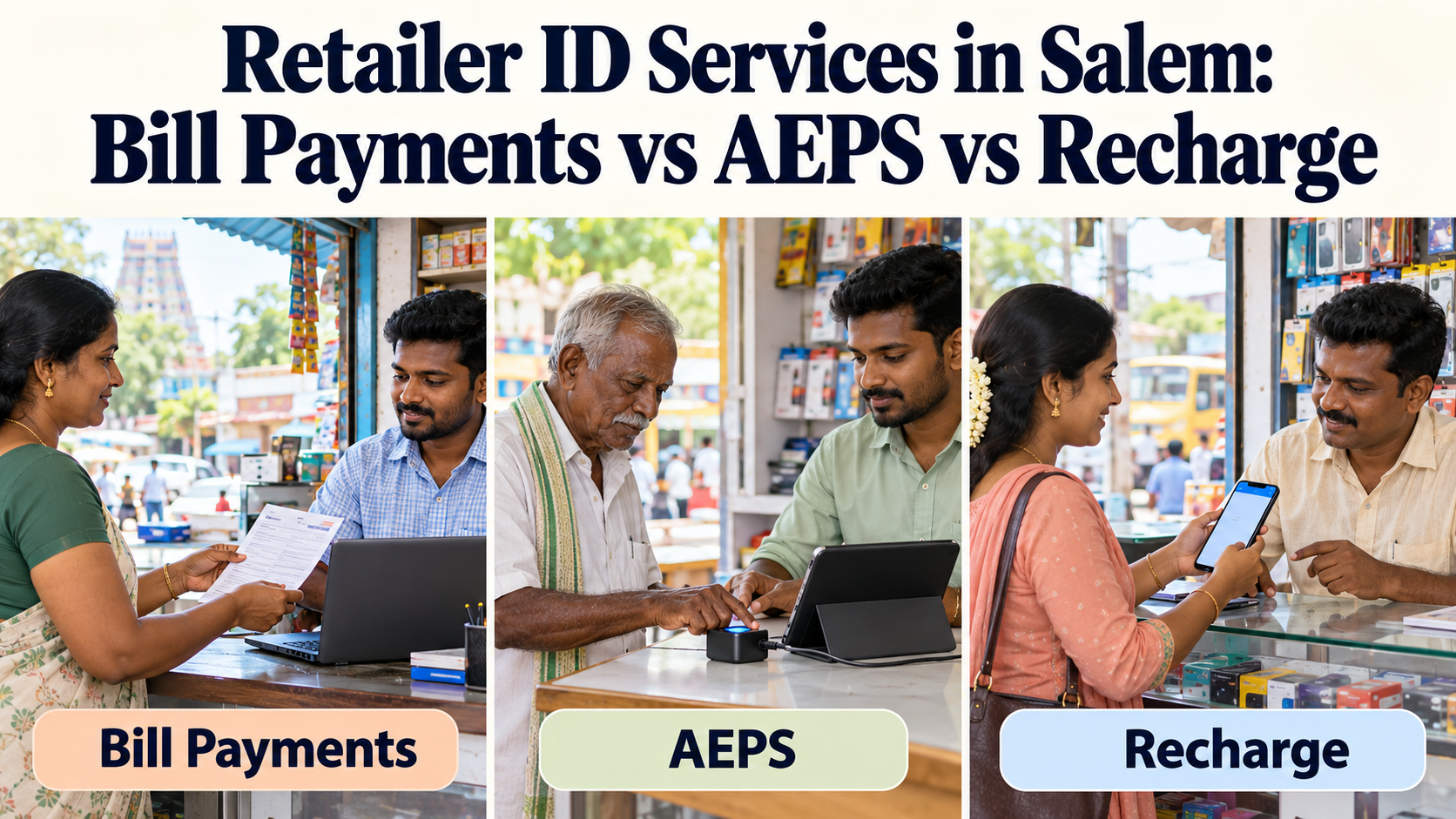
Retailer ID Services in Salem: Bill Payments vs AEPS vs Recharge
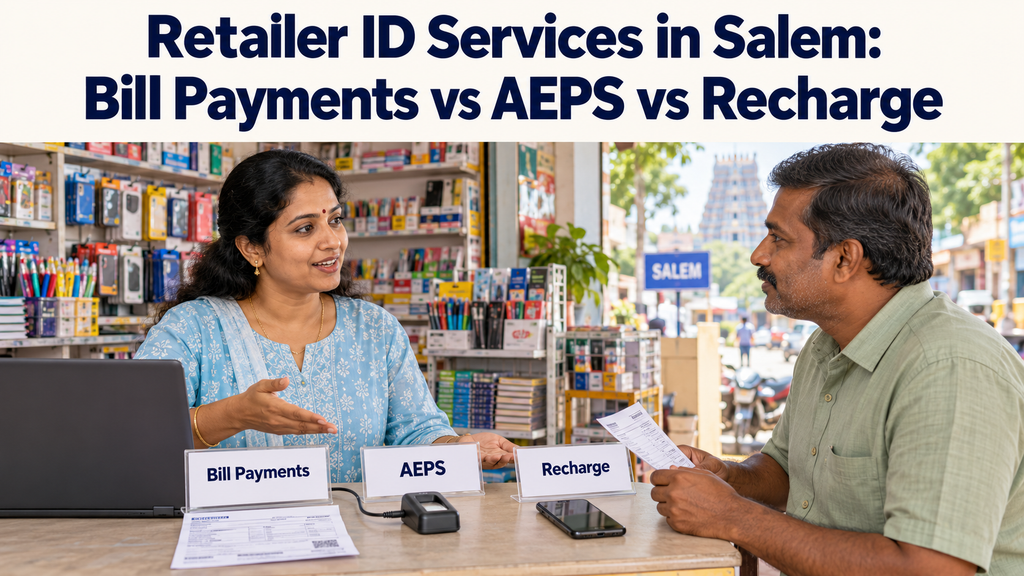
Retailer ID services are not all the same kind of work. Paying an electricity bill, handing out cash through AEPS and recharging a mobile phone each bring a different customer, need different preparation and carry different risks. Knowing those differences helps a Salem shop owner decide where to put time, cash and attention.
This article compares the three services most counters offer first: bill payments through BBPS, AEPS cash services and mobile or DTH recharge. It looks at each one side by side, so you can see which fits your shop, your location and your customers in Salem, Attur, Namakkal, Erode and Mettur.
For the basics of what a retailer ID is and how to apply, read our guide to the retailer ID in Salem. Here we go straight to the comparison.
Table of Contents
The Three Retailer ID Services at a Glance
Before looking at each service in detail, it helps to see them together. The table below summarises how they differ in everyday use at a small counter.
| Point | Bill payments (BBPS) | AEPS | Recharge |
|---|---|---|---|
| What the customer wants | To pay a utility, loan, insurance or other bill | Cash, a balance check or a mini statement from their bank account | Talk time, data or DTH balance |
| How often they come | Usually monthly, around due dates | Whenever cash is needed, often on wage or market days | Frequently, whenever a plan runs out |
| What you need | Smartphone, data, wallet balance | Smartphone, fingerprint device, cash in the drawer | Smartphone, data, wallet balance |
| Money flow | Cash in, wallet down | Cash out, wallet up | Cash in, wallet down |
| Care needed | Correct biller and consumer number | Customer privacy, correct amount, success before cash | Correct number, operator and plan |
| Customer type | Households, shop owners, elderly customers | Pensioners, workers, rural and semi-urban families | Students, workers, families |
None of these retailer ID services is better in every way. Each one fills a gap the others leave. The rest of this guide explains why, and how to judge the mix that suits your counter.
Bill Payments Through BBPS: The Monthly Regular
Bill payments run through the Bharat Bill Payment System. The YoursPay BBPS franchise page lists electricity, water, gas, broadband, landline, postpaid, insurance, loan repayments, FASTag, mobile and DTH among the categories at the time of writing.
The strength of bill payments is rhythm. Bills fall due every month or every billing cycle, so a customer who trusts your counter tends to come back on a regular schedule. The YoursPay page calls this recurring visits that build loyal footfall.
What makes a good bill payment counter:
- Checking the biller name and consumer number with the customer before paying.
- Confirming the amount and due date shown on the bill.
- Giving a receipt with the transaction reference every time.
- Telling the customer calmly when a payment shows pending, instead of paying twice.
As retailer ID services go, bill payments suit patient, organised shop owners. The work is not rushed, but mistakes such as a wrong consumer number can take effort to fix. Our guide to bill payment services in Salem covers the checks customers look for.
AEPS: The Cash-Need Retailer ID Service
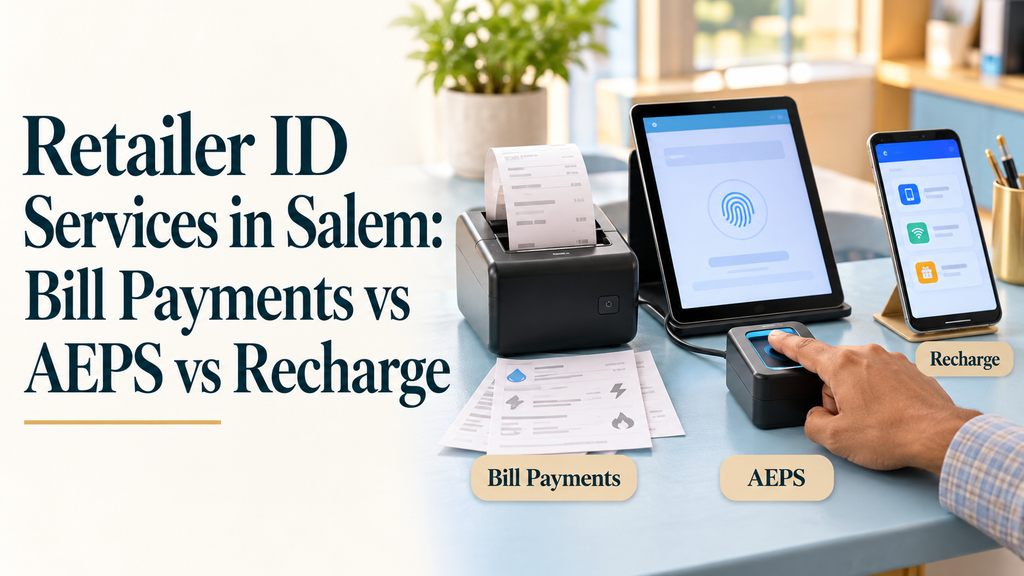
AEPS, the Aadhaar Enabled Payment System, lets a customer withdraw cash, check their balance or see a mini statement using their Aadhaar number and fingerprint. The YoursPay AEPS page notes that no debit card or PIN is needed and that it works on a basic smartphone with a biometric device.
AEPS is different from the other two retailer ID services in one important way: money flows out of your drawer. When a customer withdraws cash, you pay it from your own notes and the amount is credited to your wallet. That means you must keep enough cash on hand for busy periods.
AEPS tends to bring customers who might never come in for a recharge. Elderly people, pensioners, farm workers and families far from a bank branch or ATM often value a nearby counter where a fingerprint is enough.
What makes a good AEPS counter:
- The customer places their own finger on the device and sees the amount on screen.
- Cash is handed over only after the app shows the transaction as successful.
- The customer gets a slip or message with the reference.
- Aadhaar details are never written down or kept by the shop.
For official information on Aadhaar and authentication, the UIDAI website is the right source. For how AEPS works across banks, see the NPCI website.
Mobile and DTH Recharge: The Quick, Frequent One
Recharge is usually the fastest of the three retailer ID services. The YoursPay retailer page describes instant prepaid, postpaid and DTH recharges for all operators at the time of writing. A customer gives a number, picks a plan, pays and leaves.
Its strength as a retailer ID service is frequency. Many customers recharge often, and each visit is short. Recharge fills the quiet minutes between bigger jobs and brings in younger customers who may later use other services.
Its weakness is competition. Many people now recharge through apps on their own phones. Counter recharge mainly serves customers who prefer to pay cash, who have basic phones, or who want help choosing a plan.
What makes a good recharge counter:
- Reading the mobile number back to the customer before confirming.
- Checking the operator and circle, especially for new numbers.
- Explaining plan validity and data clearly, without pushing a costlier plan.
- Helping customers whose recharge shows pending, rather than recharging again.
How Money Moves in Each Service
Understanding money flow is essential when you run several retailer ID services together. It decides how much wallet balance and drawer cash you need each morning.
| Service | Drawer cash | Wallet balance | What to plan |
|---|---|---|---|
| Bill payment | Goes up | Goes down | Enough wallet balance around due dates |
| Recharge | Goes up | Goes down | Steady wallet balance all day |
| AEPS withdrawal | Goes down | Goes up | Enough notes for withdrawal peaks |
| AEPS balance or mini statement | No change | No change | Device and connection ready |
There is a useful balance here. Bills and recharges add cash to the drawer and use up wallet balance. AEPS withdrawals do the opposite. A counter that offers all three can sometimes use cash from bill payers to serve withdrawal customers, though you should always keep retailer cash separate from shop sales and track it carefully.
Time and Attention Each Service Needs
Counter time is limited for any retailer ID holder, especially if you also run a provision store, mobile shop or other business. It helps to know which retailer ID services need your full attention.
- Recharge: usually quick once you are familiar with the app. Low attention, but check the number every time.
- Bill payment: a little longer, because you read the bill, enter the consumer number and confirm details.
- AEPS: needs full attention. You handle cash, manage the fingerprint step, count notes and deal with occasional failed attempts.
Think about when each service is busiest. If AEPS peaks at the same hour your main shop is crowded, you may need a family member to help. If bill payments cluster near due dates, plan those days in advance.
Comparing Commission Without Guesswork
Every shop owner wants to know which service earns more. The honest answer is that you need the current commission sheet in writing before you can compare. Commission can be structured differently for different services, and it can change. Do not rely on what another retailer tells you.
Once you have the sheet, a useful way to compare is commission per minute of counter time, not just commission per transaction. The figures below are made up purely to show the method. They are not YoursPay rates.
| Service | Example commission | Example minutes taken | Example commission per minute |
|---|---|---|---|
| Recharge | Rs 1 | 1 | Rs 1.00 |
| Bill payment | Rs 2 | 3 | Rs 0.67 |
| AEPS withdrawal | Rs 4 | 4 | Rs 1.00 |
In this imaginary example, the service with the highest commission per transaction is not automatically the best use of time. Replace every figure with your real commission and your own timings. The result will often surprise you.
To collect your own timings, keep a watch or phone clock in view for one ordinary week. Note roughly how long each bill payment, recharge and AEPS withdrawal takes from greeting to receipt. A few dozen entries per service are enough to see a clear pattern for your retailer ID counter.
Remember too that one service can bring customers for another. A bill payer who also recharges, or an AEPS customer who buys groceries, adds value that a per-minute figure does not show.
Which Service Fits Which Shop and Location
Location shapes demand for retailer ID services more than any other factor. The table below gives general tendencies, not rules. Your own customer notes are the real guide.
| Shop or area | Service that often leads | Why |
|---|---|---|
| Residential street in Salem city | Bill payments | Households with regular utility and broadband bills |
| Village or small town far from ATMs | AEPS | Customers need cash nearby without travelling |
| Near a college or bus stand | Recharge | Frequent small recharges by students and travellers |
| Weekly market area | AEPS and recharge | Cash needs and quick top-ups on market days |
| Busy main road with many shops | Bill payments and recharge | Passing traffic and working customers |
If your shop sits between two of these types, such as a residential street near a bus stand, you may see a mix of retailer ID services from the start. Let the first two months of records guide where you focus.
For a wider look at how assisted digital services help rural customers, see our article on digital banking in rural India.
Seasonal Patterns Across the Three Services
Demand for retailer ID services also changes through the year. Watching these patterns helps you prepare float, cash and staff before the busy weeks arrive, instead of reacting once the queue has formed.
- Festival months: around Deepavali and Pongal, cash needs rise, so AEPS withdrawals may increase. Ticket and recharge requests can also go up as families travel.
- Summer: electricity use often rises, and so can the size of bills that customers bring to the counter.
- School and college reopening: students and parents may need more recharges and data plans.
- Harvest and wage cycles: in farming areas, cash needs can follow the rhythm of harvest payments and weekly wages.
Write down what you notice each month. After a year, your own notes will show which of the three retailer ID services peaks when, and you can plan wallet top-ups and drawer cash with far more confidence.
Setting Up One Counter for All Three Services
A little thought about layout makes three services easier to run side by side. You do not need a big space, just a clear arrangement that keeps money and devices organised.
- Fingerprint device placement: keep it where the customer can reach it comfortably and see the screen, not hidden behind stock.
- Separate cash pouch: keep retailer cash for bills, recharges and AEPS apart from your normal shop sales.
- Service board: list the retailer ID services you offer in Tamil and English, with any customer charges shown clearly.
- Receipt option: a small printer or a habit of sharing digital receipts helps every service.
- Charging point: keep your phone and device charged, with a backup for power cuts.
A tidy counter also reassures customers. People handing over bills or placing a fingerprint want to see an organised, professional setup.
Risks and Customer Care Compared
Each of the three retailer ID services has its own common problems. Knowing them in advance makes it easier to protect customers and your reputation.
- Bill payments: wrong consumer number, paying the wrong biller, or paying twice when the first attempt shows pending.
- AEPS: handing over cash before success is confirmed, counting errors, failed fingerprint attempts, and customers who are unsure of their balance.
- Recharge: wrong mobile number, wrong operator, or a plan that does not match what the customer expected.
The common fix across all three is simple: slow down at the confirmation step. Read details back, wait for a clear status, and give a receipt. When something does go wrong, note the reference number and follow the complaint process YoursPay explains to you.
Honesty about charges matters in every service. If any customer charge applies, tell the customer before you begin. Hidden amounts damage trust faster than any technical failure.
Why Most Counters Offer All Three Together
Comparing the three services is useful, but most successful counters do not choose just one. The services support each other in practical ways:
- Steady base: bill payments bring predictable monthly visits.
- New reach: AEPS brings customers who need cash and may not visit otherwise.
- Filler traffic: recharges keep the counter active between bigger jobs.
- Cash balance: cash from bills and recharges can help cover AEPS withdrawals, with careful tracking.
- One-stop trust: customers prefer a single counter that handles most of their small money needs.
The YoursPay retailer ID also covers money transfer, FASTag and ticket booking at the time of writing. These can be added later once the three core retailer ID services run smoothly. For a short explainer on AEPS and Aadhaar Pay together, read our AEPS and Aadhaar Pay guide.
Questions to Ask Before You Choose Your Mix
Before deciding how much effort to put into each service, ask the YoursPay team these questions and keep the answers in writing:
- What is the current commission for each service, and how is it calculated?
- Are there any customer charges I must display or explain?
- What fingerprint device is recommended for AEPS, and how do I get it?
- How are failed and pending transactions handled for each service?
- How quickly is commission credited, and how is it settled to my bank?
- What training is available before I start a new service?
Clear answers help you compare retailer ID services on facts rather than guesses, and they protect you if terms change later.
Frequently Asked Questions
Which retailer ID services should I start with?
Many shops begin with bill payments and recharge because they need only a smartphone and wallet balance. AEPS can follow once you have a fingerprint device and enough cash planning.
Does AEPS need more cash at the counter?
Yes. For withdrawals, you hand cash to the customer and the amount is credited to your wallet. Keep enough notes for busy days.
Which service earns the most commission?
It depends on the current commission sheet and how long each service takes. Get the sheet in writing and compare commission per minute of counter time.
Is recharge still useful when people use apps?
For many counters, yes. Customers who pay cash, use basic phones or want help choosing a plan still prefer a local shop.
What equipment do I need for these services?
According to the YoursPay FAQ, a smartphone is enough to start. A low-cost fingerprint scanner is recommended for AEPS, and the team can help you source one.
Can one person handle all three retailer ID services?
Yes, at most small counters. It helps to plan busy hours, keep float and cash ready, and train a family member if AEPS peaks when your main shop is crowded.
Is income from retailer ID services guaranteed?
No. Earnings depend on transaction volume. YoursPay states clearly that no income is guaranteed.
Want to offer bill payments, AEPS and recharge from one counter? Visit the YoursPay retailer ID page or contact YoursPay to discuss onboarding and request the current commission sheet in writing.
This article is general information, not financial advice. Service details are taken from the YoursPay website at the time of writing and may change. Commission figures in the example are hypothetical. Please confirm current terms in writing.