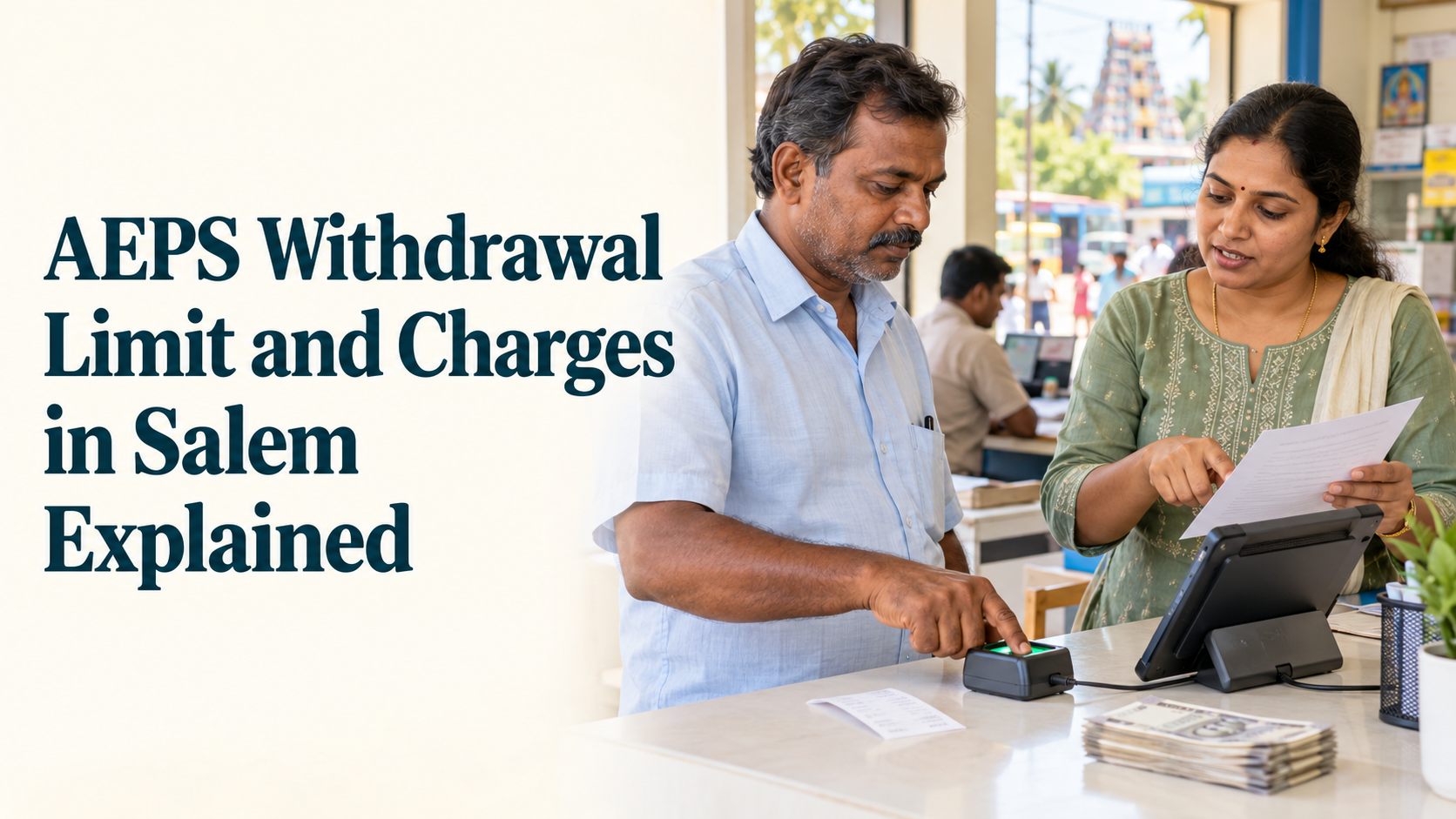
AEPS Withdrawal Limit and Charges in Salem Explained
The AEPS withdrawal limit decides how much cash you can take out using your Aadhaar and fingerprint in one go, in one day or over a longer period. Many people in Salem only discover these limits when a withdrawal is declined at the counter. Knowing how limits and charges work beforehand saves you a wasted trip and an awkward moment.
This guide explains why limits exist, the different kinds you may meet, who sets them, how AEPS charges work for customers and retailers, and exactly where to check the latest rules. It deliberately does not quote fixed rupee figures, because limits and charges are set by NPCI and banks and are revised from time to time. Instead, it shows you how to find the figure that applies to your own account today.
It is written for families, pensioners, farmers, workers and shop owners in Salem, Attur, Namakkal, Erode and Mettur. YoursPay details come from its website at the time of writing, so please confirm current terms before you rely on them.
Table of Contents
Why an AEPS Withdrawal Limit Exists
AEPS, the Aadhaar Enabled Payment System, is run by the National Payments Corporation of India (NPCI). Aadhaar authentication is handled by UIDAI, and the money itself sits in your bank account. Each of these parties has reasons to cap how much can move through a single fingerprint transaction.
- Protecting customers: if someone ever misuses a person’s biometrics, a limit reduces how much could be withdrawn before it is noticed.
- Managing risk for banks: AEPS transactions happen away from bank branches, so banks control exposure through limits.
- Practical cash handling: AEPS points are usually small shops, which cannot keep very large amounts of cash in the drawer.
- Keeping the network stable: network-level rules keep transactions within a range the system is designed to handle.
Seen this way, the AEPS withdrawal limit is less an inconvenience and more a safety feature. It is designed for everyday cash needs, not for very large withdrawals.
The Different Kinds of AEPS Limits
People often talk about “the limit” as if there were only one. In practice, several limits can apply to the same withdrawal, and the lowest one decides what you can take out. The table below lists the common types without quoting figures, since those change.
| Type of limit | What it controls | Who usually sets it |
|---|---|---|
| Per-transaction limit | The most you can withdraw in a single AEPS transaction | NPCI rules, with banks able to apply their own caps |
| Daily or monthly limit | The total you can withdraw over a day or a month | Your bank, within network rules |
| Number of transactions | How many AEPS transactions you can make in a period | Your bank or network rules |
| Account-type limit | Overall caps on certain small or basic accounts | Your bank, as per banking rules for that account type |
| Operator or app limit | What a particular retailer app or BC point allows | The service provider |
| Available balance and cash | What is in your account and in the shop’s drawer | Your account balance and the shop’s cash on hand |
So if a withdrawal is declined, it does not always mean you crossed the network limit. It could be a bank cap, an account-type cap, the app’s own limit or simply low balance.
Who Sets the Limits: NPCI, Your Bank and the Provider
Think of the AEPS withdrawal limit as a set of layers. Each layer can be equal to or stricter than the one above it, but not looser.
- NPCI sets the rules for the AEPS network as a whole, including limits that apply across banks.
- Your bank can apply its own limits for its customers, which may differ from another bank’s.
- The service provider behind the retailer app can set limits for its operators and points.
- The shop may only be able to pay out what it has in cash that day.
This is why two people withdrawing at the same YoursPay point on the same day may see different outcomes. Their banks, account types and balances differ. It is also why a figure you heard from a neighbour, or read in an old article, may not match what your own bank allows today.
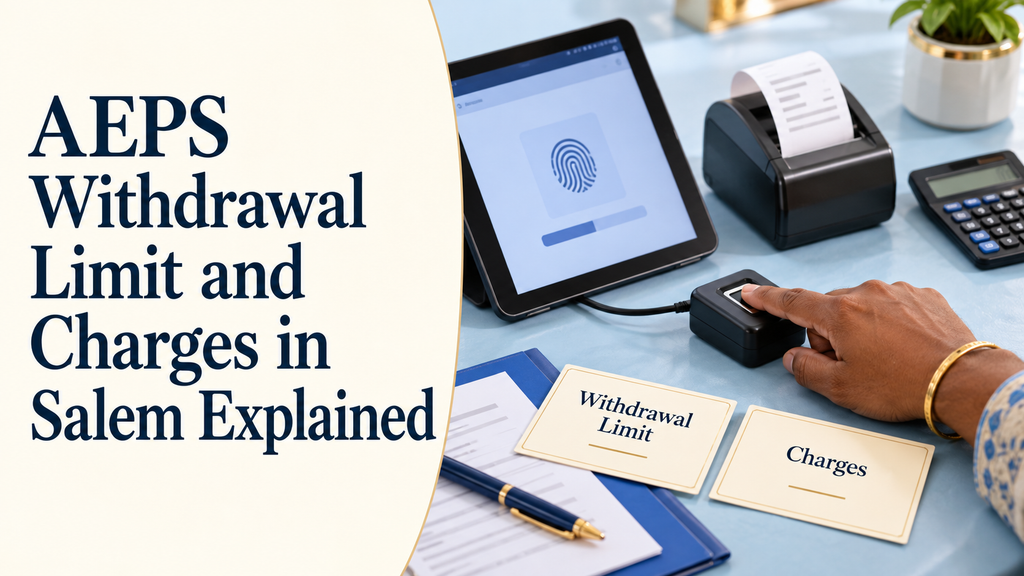
Understanding AEPS Charges for Customers
AEPS charges are the second question most customers have. There are two places where a cost could arise, and it helps to keep them separate.
Your bank’s side: banks publish a schedule of charges for their accounts. Some banks may count AEPS transactions within the free transactions allowed on your account, and some may apply charges beyond a certain number. Rules differ by bank and account type and are revised from time to time, so the only reliable source is your own bank’s current schedule of charges.
The counter’s side: the shop or BC point runs the service. Whether any service charge applies at the counter depends on the provider’s rules. If a counter charges anything, it should tell you clearly before the transaction, not after.
Always check your bank SMS after a withdrawal. It shows the amount debited from your account. If the debit is higher than the cash you received and you were not told of any charge, raise it with the operator and your bank.
Where to Check the Current Limit and Charges
Because AEPS limits and AEPS charges change, the right habit is to check the latest figures from official sources before a large or unusual withdrawal. These are the most reliable places to look:
- Your bank branch: ask staff for the AEPS withdrawal limit and any charges on your specific account type. Request it in writing or ask them to show the official notice.
- Your bank’s website: most banks publish a schedule of service charges and notices on digital transactions.
- Your bank’s customer care: use only the number printed on your passbook or on the bank’s official website.
- The NPCI website: the NPCI website has a section on AEPS with product information and circulars.
- The AEPS operator: a good operator can tell you the app’s limits and any counter charges before you start.
For broader rules on banking charges and customer rights, the Reserve Bank of India website publishes guidelines and explains how to raise a complaint if your bank does not resolve an issue.
How Your Account Type Can Change the Picture
Not every bank account is treated the same way. The type of account you hold can affect both the AEPS withdrawal limit and any AEPS charges, even within the same bank.
- Regular savings accounts usually follow the bank’s standard AEPS rules and schedule of charges.
- Basic or small accounts opened with simplified KYC can carry overall limits on balances, credits or withdrawals under banking rules. These caps can apply before any AEPS limit does.
- Accounts used for pensions or scheme benefits are normally savings accounts, so the bank’s usual rules apply. Ask your branch if you are unsure.
- Joint accounts may have conditions on who can transact. Ask the bank how AEPS applies to your joint account.
If you often hit a limit, ask your branch whether a different account type or completing full KYC would change it. Only your bank can give a reliable answer for your account.
Balance Enquiry, Mini Statement and Charges
The AEPS service is not only for cash. You can also check your balance and view a mini statement. These do not move money, but it is worth knowing how your bank treats them.
Some banks may count every AEPS transaction, including enquiries, towards the number of free transactions on your account. Others may treat them differently. If AEPS charges apply after a certain number of transactions, frequent balance checks could use up that free allowance faster.
A sensible habit is to check your balance only when you need to, such as before a larger withdrawal, and to rely on bank SMS alerts for day-to-day tracking. Ask your bank how enquiries are counted on your account.
Planning a Larger Cash Need
The AEPS service works best for everyday amounts: groceries, school fees in small instalments, wages for a helper or a trip to the market. When you need a larger sum, plan ahead rather than trying to force it through an AEPS point.
- Visit your bank branch for large withdrawals, such as for a family function, crop inputs or a hospital deposit.
- Use a bank transfer instead of cash where the receiver accepts it, for example to a supplier or a hospital account.
- Spread routine withdrawals across the week within the rules, so you never need a single large AEPS transaction.
- Check the balance first with a quick AEPS balance enquiry, so you know what is available.
Say a farmer near Mettur needs cash to pay for seed and fertiliser at the start of a season. An example plan would be to pay the dealer directly by bank transfer or UPI where possible, and use AEPS only for small labour payments. This is a hypothetical example, but it shows how to work with limits instead of against them.
What Happens When You Hit a Limit
When a withdrawal crosses the AEPS withdrawal limit or any other cap, the transaction is usually declined and the screen shows a message. The wording varies, but it may mention a limit, a count exceeded, or simply a decline from the bank.
If this happens:
- Read the message and ask the operator to explain it.
- Do not keep retrying with the same amount. Repeated attempts will not change the limit.
- Ask for the receipt or note the reference number, even for a declined transaction.
- Check your bank SMS to make sure no money was debited.
- If you still need cash, try a smaller amount or plan a branch visit.
A declined transaction should not take money from your account. If your account shows a debit but you did not get the cash, keep the receipt or reference number and contact your bank. Banks normally check and reverse such debits.
Avoiding Overcharging at the Counter
Most operators offering the AEPS service in Salem district are honest shopkeepers who value repeat customers. Still, it is wise to protect yourself with a few simple habits.
- Ask before you start: “Is there any charge for this withdrawal?” A clear answer upfront avoids disputes.
- Check the amount on screen: the amount entered should match what you asked for.
- Match three numbers: the cash in your hand, the receipt and the bank SMS.
- Keep your receipt: it is your evidence if something does not add up.
- Report problems: tell the service provider and your bank if you feel you were overcharged.
Our guide on how to read a payment receipt explains the fields you should check on an AEPS slip.
A Note for Retailers Offering the AEPS Service
If you run an AEPS point, clear communication about limits and charges builds trust. Customers who feel informed come back, and those who feel surprised do not.
- Display a simple notice that limits apply and that they depend on the customer’s bank.
- Be transparent about any service charge and follow your provider’s rules on what is allowed.
- Never split one withdrawal into several transactions to get around a limit. Limits exist for safety, and bypassing them can breach your provider’s rules.
- Keep enough cash on busy days, such as when wages or benefits are usually credited.
- Know your earnings terms: any commission on AEPS transactions depends on your provider’s current terms, so get them in writing.
The YoursPay AEPS services page notes that the service can add a steady earning stream for retailers. As always, actual earnings depend on usage and current terms.
Keep a Simple Record of Your Withdrawals
A small notebook or a note on your phone makes limits and charges much easier to manage. For every withdrawal, write the date, the amount, the bank, the counter and the reference number from the receipt.
Over a month, this record shows how often you use AEPS, whether you are close to your bank’s AEPS withdrawal limit, and whether any AEPS charges appear on your passbook or statement. If a debit ever looks wrong, the record and the receipt together make it far quicker for your bank to trace the transaction.
Quick Checklist Before an AEPS Withdrawal
Keep this short list in mind every time you visit an AEPS point, especially for a larger amount.
- Is my Aadhaar linked to the account I want to use?
- Do I know my bank’s current AEPS withdrawal limit for my account type?
- Have I checked my balance recently?
- Did the operator tell me about any charge before starting?
- Did I get a receipt, and does it match my cash and bank SMS?
For more on how AEPS and Aadhaar Pay differ, read our AEPS and Aadhaar Pay guide. For the wider local picture, see our article on digital banking in Salem.
Frequently Asked Questions
What is the AEPS withdrawal limit?
It is the maximum amount you can withdraw through AEPS per transaction and over a period. The exact figures are set by NPCI and your bank and can change, so check with your bank for the current limit on your account.
Why was my AEPS withdrawal declined when I had enough balance?
You may have crossed a per-transaction, daily or monthly limit, a limit on the number of transactions, or a cap on your account type. The app or provider may also have its own limit. Try a smaller amount or ask your bank.
Are there AEPS charges for customers?
It depends on your bank and account type. Some banks may apply charges beyond a certain number of transactions. Check your bank’s current schedule of charges, and ask the operator about any counter charge before you start.
Do limits differ from bank to bank?
Yes. NPCI sets network-level rules, and each bank can apply its own limits for its customers. That is why two people at the same counter can have different limits.
Can the operator split my withdrawal to cross the limit?
An operator should not split one withdrawal into several transactions to get around a limit. For larger amounts, visit your bank branch or use a bank transfer instead.
Do balance enquiries count towards AEPS charges?
At some banks they may count towards your number of free transactions. Ask your bank how AEPS enquiries are treated on your account type.
Where can I find official information on AEPS?
Your bank is the first source for your account’s limits and charges. The NPCI website has product information on AEPS, and the RBI website explains banking rules and complaint channels.
Have a question about withdrawing cash near you? Visit the AEPS services page or contact YoursPay in Salem, and confirm your bank’s current limits before a large withdrawal.
This article is general information, not financial advice. AEPS limits and charges are set by NPCI, banks and service providers, and they change from time to time. YoursPay details are taken from its website at the time of writing. Please confirm current limits and charges with your bank before you transact.