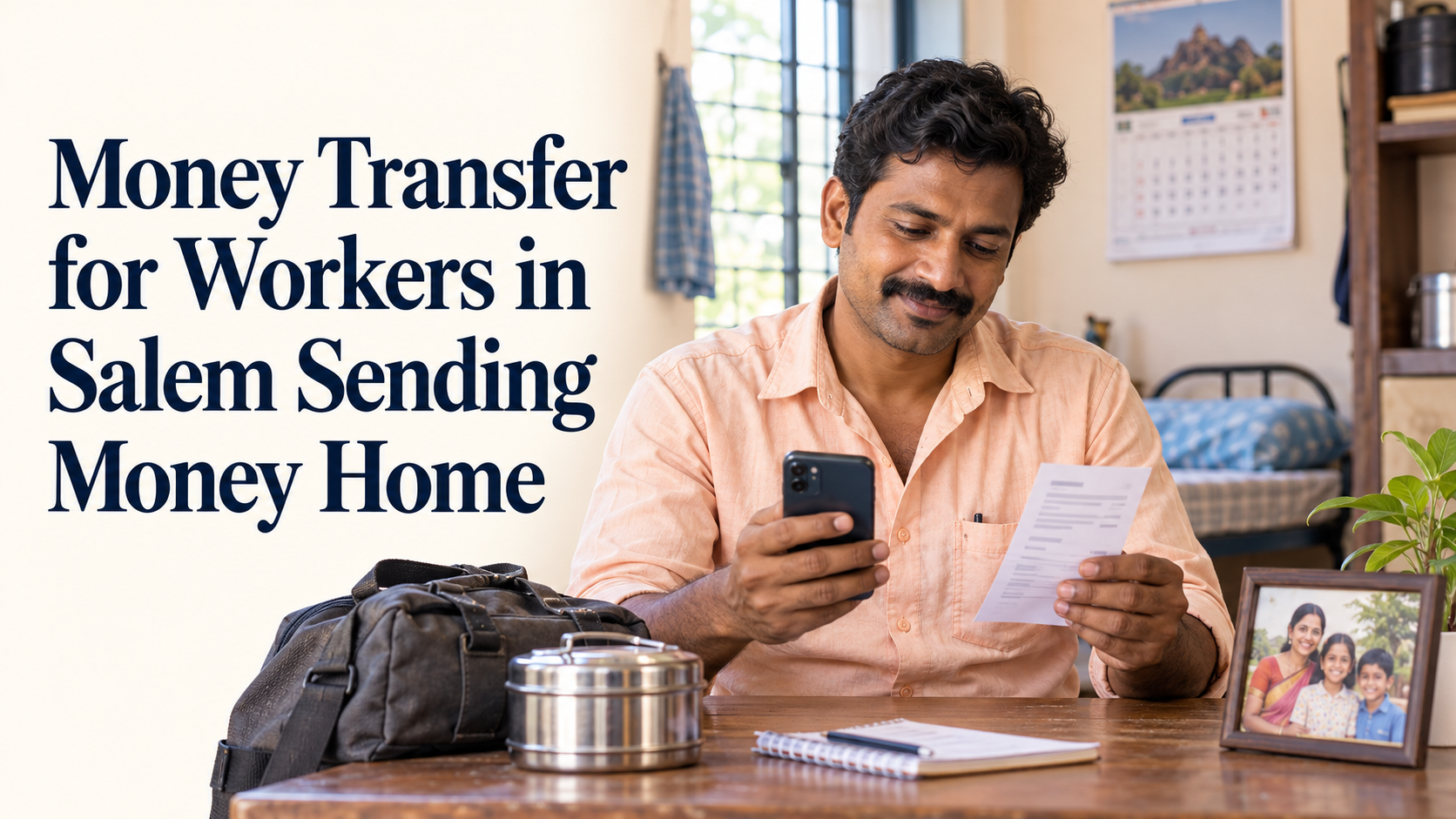
Money Transfer for Workers in Salem Sending Money Home
Money transfer for workers is about more than a single trip to a counter. If you work in Salem and support parents, a spouse or children in another district or state, sending part of every wage home is one of the most important jobs you do each month. Doing it safely and on time protects both your earnings and your family’s plans.
Salem draws workers into textile and powerloom units, construction sites, hotels, sago and food processing units, transport and small workshops. Many of them are paid weekly or monthly, often in cash, and need a reliable way to send money home without losing a day’s work or carrying large amounts on a train.
This guide is written for those workers, and for the contractors and shop owners who help them. Service details for YoursPay are taken from its website at the time of writing, so confirm the current terms at the counter before you send.
Table of Contents
Why Money Transfer for Workers Needs a Plan
A worker’s income and a family’s expenses rarely arrive on the same day. Wages may come every Saturday, while school fees, loan instalments and ration purchases back home fall due on fixed dates. Without a plan, money reaches home late, or is spent in the city before it can be sent.
There are also risks that office workers do not face as often:
- Cash in a shared room: keeping weeks of wages in a bag or box where many people stay is risky.
- Long journeys with cash: carrying savings on a bus or train home invites theft and loss.
- Informal carriers: handing money to a friend or agent who is travelling depends entirely on trust.
- Lost working hours: a long wait at a crowded bank branch can mean a lost half-day of wages.
A simple, regular system for money transfer for workers solves most of these problems. Your wages move quickly from your hand to your family’s bank account, and you keep clear proof of every rupee you send.
Step One: Set Up the Receiving Account at Home
A transfer is only as good as the account it goes into. Before you start a routine to send money home, make sure someone at home has a working bank account that they can use easily.
- Choose the right account holder: usually a parent or spouse who lives at home and can visit a bank branch or local service point.
- Check the account is active: accounts that have not been used for a long time can become inactive. Ask your family to update KYC at their branch if needed.
- Link a mobile number: when the account sends SMS alerts, your family knows the moment money arrives.
- Link Aadhaar with the account: this can make it easier for the family to withdraw cash at a nearby banking point in the village.
If a family member does not yet have an account, a basic savings account at a nearby bank is a good start. The government’s financial inclusion scheme, described on the Pradhan Mantri Jan Dhan Yojana website, was set up to help households open basic bank accounts. The family can ask at their bank branch which account suits them.
Finally, ask your family to send you a clear photo of the passbook’s first page. It shows the account holder’s name, account number and IFSC, which are the details the counter needs.
What You Need at a Counter in Salem
A walk-in money transfer service in Salem is designed for people who want to send cash straight into a bank account. The YoursPay page describes its Domestic Money Transfer service as ideal for migrant workers, families and small businesses, and available across its retailer and business correspondent network.
Keep these items together in one pouch so you are ready on sending day:
- The passbook photo or a written card with the family’s account holder name, account number and IFSC.
- Your own ID for KYC verification. Ask the counter which ID they accept.
- The mobile phone that receives your SMS alerts.
- The cash you plan to send, plus the service charge.
According to the service page, you can pay by cash, wallet or registered account, and the transfer is credited in real time, subject to the receiving bank, with an SMS confirmation. The page also mentions local-language support at every counter.

Choose a Regular Day to Send Money Home
A fixed sending day turns a worry into a habit. Pick one that falls soon after your wage day, so the money leaves your hands before it can be spent or lost.
When choosing the day, think about three things:
- Your wage cycle: if you are paid on Saturday, a Sunday or Monday visit to the counter may suit you. Check the counter’s opening days first, because some service points close on Sundays.
- Your family’s due dates: school fees, loan repayments, rent and medicine purchases should be covered before their dates, not after.
- Your working hours: choose a time when the counter is less busy, such as early morning or after your shift.
Some workers prefer to send money home once a month, while others send smaller amounts every week. Weekly transfers keep less cash in your room, but each transfer may carry its own service charge. Ask the counter about the charge for different amounts, then choose the pattern that balances safety and cost for you.
A Simple Way to Split Your Wages
Many workers send almost everything home and are left short in the city. Others spend more than they intended and send less. A simple split, written down once, helps you avoid both problems.
The table below is only an example. Say a worker earns Rs 18,000 in a month. One possible split could look like this:
| Purpose | Example amount | Note |
|---|---|---|
| Room, food and travel in Salem | Rs 6,500 | Your own living costs come first |
| Money sent home | Rs 9,000 | Sent on a fixed day through a counter |
| Emergency savings | Rs 1,500 | Kept in your own bank account, not in cash |
| Transfer charges and phone | Rs 500 | Ask the counter for the exact charge |
| Small personal spending | Rs 500 | A fixed limit you can stick to |
Your own numbers will be different. The point is to decide the amounts in advance and to keep a small emergency fund of your own. Our guide on how to save money on an irregular income has more ideas for workers whose wages change from week to week.
Keep Proof of Every Transfer
Proof matters. If a transfer is delayed, or if there is ever a family disagreement about how much was sent, your receipts and SMS messages tell the full story.
After each money transfer, do these three things before you leave the counter:
- Read the SMS on your phone and check the amount.
- Check the receipt for the date, amount, charge, account details and reference number.
- Call or message your family to tell them the amount and ask them to check their alerts.
If you are not sure what each number on a receipt means, our guide on how to read a payment receipt explains it simply.
A small notebook helps too. Draw four columns: date, amount sent, charge paid and reference number. Over a year, this record shows exactly how much you have sent home, which can help when you plan larger goals like a house repair or a family function.

How Your Family Can Use the Money at Home
Once the money transfer reaches the family’s account, they have several ways to use it. They do not always need to travel to a town bank branch.
- Bank branch or ATM: the usual option if a branch or ATM is nearby and the family has a debit card.
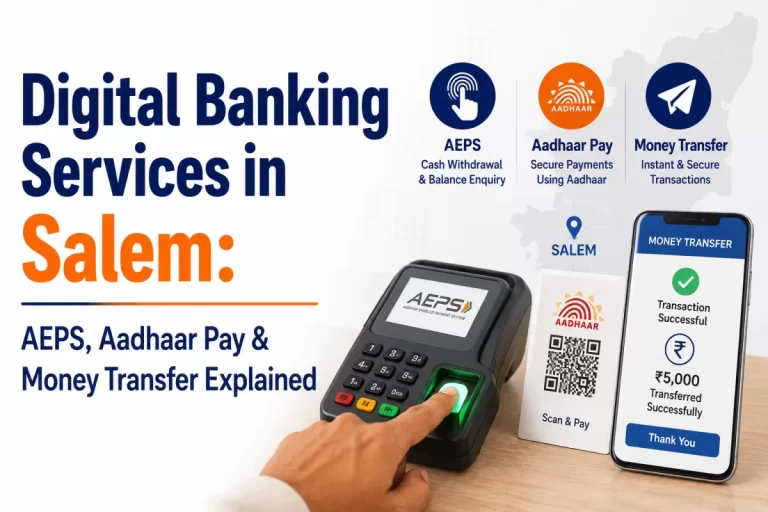
- Aadhaar-based withdrawal: at many village service points, a family member can withdraw cash from an Aadhaar-linked account using their Aadhaar number and fingerprint. This is called AEPS.
- Bill payments: electricity, mobile recharge and similar bills can often be paid at a local service point. See our guide to bill payment services for how this works.
- Leaving some money in the account: a small balance kept in the bank is safer than cash kept at home.
Encourage your family to withdraw only what they need for the week. Money left in the account is protected from loss at home and is easy to track through the passbook or SMS alerts.
Common Risks and How Workers Can Avoid Them
Workers far from home are often targeted by people who know they carry cash and support families. A few habits keep your hard-earned wages safe every time you send money home.
- Do not hand cash to unknown agents: someone who offers to “deliver” your money home for a fee may simply disappear with it.
- Keep your ATM card and PIN private: do not share them with roommates, co-workers or supervisors, however friendly.
- Keep your own ID documents: your Aadhaar card and bank passbook should stay with you, not with anyone else.
- Ignore calls asking for OTPs: no bank or counter needs your OTP over a phone call from a stranger.
- Be careful with loan and job offers on phone messages: requests to pay a “processing fee” before you get a job or loan are a common trick.
- Check new account numbers by voice: if someone messages a new account number “from home”, call your family on their usual number before you send.
If you are cheated, report it quickly on the National Cyber Crime Reporting Portal at cybercrime.gov.in or call 1930, and tell your bank and the counter that made the transfer. Speed matters when reporting fraud.
Language, Timing and Other Practical Help
Workers who come from other states may not speak Tamil well. The YoursPay page mentions local-language support at every counter. Even so, it helps to carry the family’s details in writing every time you send money home, so there is no confusion over names or numbers spoken aloud.
Timing also matters. The YoursPay branch in Hasthampatti, Salem, is open Monday to Saturday from 9:30 AM to 6:00 PM and closed on Sunday, at the time of writing. Retailer counters in your area may keep different hours, so ask your nearest service point when it opens.
If you work shifts, save the counter’s phone number. A quick call before you walk over can save a wasted trip. You can also reach YoursPay on +91 98945 76238 or through the contact page to find a counter near your workplace.
Questions to Ask Before Your First Money Transfer
Your first visit to a counter is the best time to ask questions. Clear answers at the start make every later money transfer quicker and less stressful.
- What is the service charge for the amount I plan to send, and is it shown on the receipt?
- Which ID do I need to register as a sender, and is registration needed only once?
- Can you save my family’s account as a beneficiary so I do not have to give the details every time?
- What time does the counter open and close, and is it open on holidays?
- Whom should I contact if my family says the money has not arrived?
Write the answers in your notebook next to the counter’s phone number. Good money transfer for workers depends on small habits like this, repeated every month without fail.
If Your Family Says the Money Has Not Arrived
Most transfers reach quickly, but sometimes a family calls to say nothing has come. Stay calm and follow a simple order.
- Check your SMS and receipt to confirm the transfer was successful and the account details were right.
- Ask your family to check their SMS alerts and passbook entry, not just a balance guess.
- Give the bank some time, because the credit is subject to the receiving bank.
- If it still has not arrived, go back to the same counter with your receipt and reference number.
Do not send the same amount again straight away. If the first transfer is only delayed, you may end up paying twice. Let the counter check the status first.
For Contractors, Employers and Shop Owners
People who employ or serve workers can make money transfer for workers much safer with small steps.
- Pay wages into bank accounts where possible: this gives workers a record of their income and reduces cash risks in shared rooms.
- Give a simple wage slip: a written note of days worked and amount paid avoids disputes and helps workers plan transfers.
- Share the nearest counter details: a notice board with the location and hours of a trusted service point saves workers time.
- Never hold a worker’s ID or bank card: documents belong with the worker.
Shop owners near worker colonies, bus stands or industrial areas can also think about offering these services themselves. A YoursPay retailer ID includes money transfer along with bill payments and other services. You can read more on the retailer ID and BBPS page. Earnings depend on transactions, and no income is guaranteed.
For a wider view of banking services available locally, our guide to digital banking in Salem is a good next read.
Frequently Asked Questions
Can I send money home if I do not have a bank account in Salem?
Walk-in counters accept cash, and the YoursPay page lists cash as a payment option. You will still need to complete KYC verification, so carry your ID and ask the counter what is needed.
Does my family need a smartphone to receive the money?
No. The money goes into their bank account. A basic phone that receives bank SMS alerts is enough to know when it has arrived.
Is money transfer for workers available to people from other states?
The YoursPay page describes its money transfer service as ideal for migrant workers and says it can send money to bank accounts anywhere in India. Confirm the receiver’s bank details before you visit.
How often should I send money home?
There is no single right answer. Weekly money transfers keep less cash with you, while monthly transfers may mean fewer service charges. Ask the counter about charges and choose what suits your wages and your family’s due dates.
What if I lose my receipt?
Keep the SMS on your phone, which usually shows the reference number. Note the date and amount in your notebook too. The counter can often look up a transfer using these details.
Can my family withdraw cash without going to the bank branch?
If their account is linked with Aadhaar, they may be able to withdraw cash at a local banking service point using their fingerprint. They can ask a nearby service point whether it offers this.
Ready to set up a regular way to send money home? See the YoursPay money transfer page for details, or contact the Salem team to find the counter closest to your workplace.
This article is general information, not financial or legal advice. Service details are taken from the YoursPay website at the time of writing and may change. Example amounts are for illustration only. Charges, limits and credit times depend on the service provider, partner banks and payment networks, so please confirm the current terms before you send money.